 China's State Administration of Cultural Heritage (SACH) announced Thursday that four more relics sites have been listed on the World Heritage List of the United Nations Educational, Scientific and Cultural Organization (UNESCO).
So far, China has had a total of 27 World Heritage sites, ranking as the fourth largest heritage country in the world.
The four newly approved cultural heritage sites are Mount Qingcheng and Dujiangyan (Dujiang Dyke) in Sichuan Province, Longmen Grottoes in Henan Province, the imperial mausoleums of the Ming and Qing dynasties which are separately located in Hubei and Hebei provinces, and the ancient Xidi and Hongcun villages in Anhui Province.
The scenic site surrounding Mount Qingcheng and Dujiangyan was formerly submitted to the UNESCO World Heritage Committee as an applicant for both cultural and natural heritage site. However, the committee only approved it as a cultural one, saying that the committee will make an on-the-spot investigation and appraisal for the site, said Wang Jun, an official with the SACH.
Located 15 kilometers southwest of Guanxian County, Mount Qingcheng was the birthplace of Taoism. Dujiangyan, which was built 2,200 years ago, has been the world's earliest irrigation project.
Listed among China's three largest grottoes, Longmen Grottoes, which were started in 494 AD, preserves important academic data and various Buddhist art treasures.
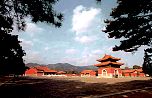
The imperial mausoleums of the Ming (1368-1644) and Qing (1644- 1911) dynasties include a total of 25 tombs of emperors, empresses and concubines.
The two ancient villages in Anhui, with a history of at least 400 years, feature traditional gardening arts and unique architecture in ancient China.
Meanwhile, the UNESCO World Heritage Committee approved the Jokhang Temple as the extension of Potala Palace, which has already been added to the World Heritage list, and five new gardens in Suzhou, Jiangsu Province, as the extension of Suzhou Gardens, which is already on World Heritage list.
The World Heritage Committee set up funds for protecting cultural and natural sites around the world in 1976.
Cultural sites are required to have historic, artistic, archeological scientific and anthropological value, while natural sites must offer distinct ecological and geographic features.
The Convention on the Protection of World Cultural and Natural Heritage, which UNESCO adopted in 1972, requires all its members to preserve and safeguard listed sites which are protected during times of war.
China joined the convention in 1985 and filed an application the following year. Six Chinese sites were added to the list in 1987-- Mount Taishan in Shandong Province; the Great Wall and the Palace Museum in Beijing; the Mogao Grottoes in Dunhuang, Gansu Province; the Tomb of Qinshihuang in Xi'an, capital of Shaanxi Province, and the Peking Man site near Zhoukoudian in southwest Beijing.
The Potala Palace in Lhasa of the Tibet Autonomous Region, the Lushan Mountains in Jiangxi Province, gardens in Suzhou, Jiangsu Province, and Lijiang in Yunnan Province are also on the list.
(Xinhua 11/30/2000)