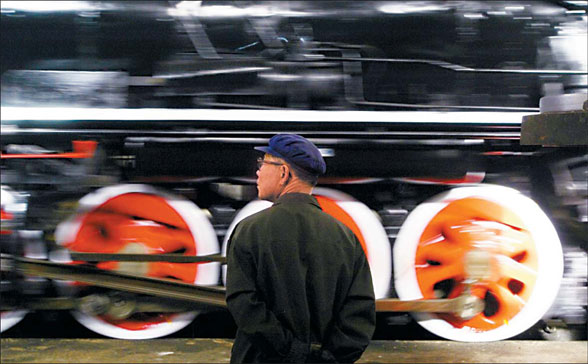
A newly repaired steam locomotive leaves the factory.
I am a steam locomotive lover. As these giants "retired" from the railways in our country in 2005, I only get to see them in a museum in my hometown of Shenyang, Liaoning province.
In 2005, a friend of mine suggested a visit to Sujiatun Steam Locomotive Repair Factory, where these engines are brought back to life.
After that, almost every weekend, I go back there to get close to both the workers and the out-of-date machines.
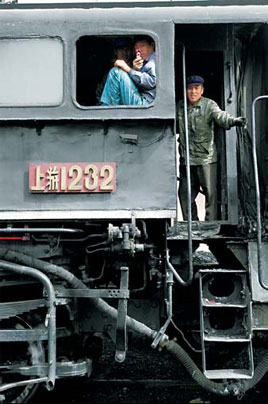
A worker takes pictures with his mobile phone.
"Please take as many photos as you like. Years later, you may see neither us nor these engines," says Zhang Yanyi, manager of the factory.
"The steam locomotives we repair are only used in some factories and mines for short-distance transportation," Zhang adds.
"Nationwide, about 200 such steam locomotives are in service."
"Our future is uncertain because these locomotives will die out after a few years."
At one time, the factory had more than 2,000 workers. The number fell to 100 in 2005 and is around 10 at present. Covering an area of 10,000 sq m, it was established in 1984.
"We are planning to add the service of repairing diesel locomotives in order to survive," Zhang tells me.
In the eyes of everybody I spoke to, I could see the pain of saying goodbye to the steam engines.
"After dealing with them for decades, they have become part of my life. I feel a little sorry to see them fading away," says Peng Zhaoxi, 64.
The factory, at the Sujiatun Depot, is connected to the local railways. If conditions permit, the steam engines are driven to the factory for maintenance. Otherwise, diesel engines are used to draw them there.
Even though diesel engines are cleaner and faster than steam ones, the steam locomotives are representative of an important period of development in China's industrial growth.
Since 1952, about 10,000 steam engines have been produced in our country, providing the backbone for rail transportation in the decades that followed. By the end of 2005, all steam engines were withdrawn from the rail tracks and the switch to diesel was complete.
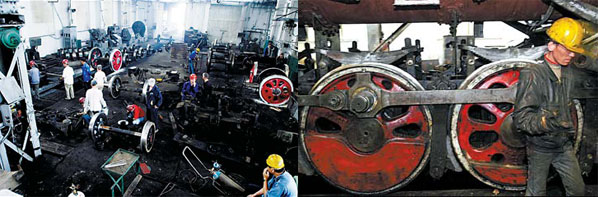
(Left): The factory, established in 1984, has witnessed a decline in business. (Right): About 200 steam locomotives nationwide are in service.
For more information about steam engines, here are some interesting links and details:
Museums:
China Railway Museum in Beijing
Shenyang Steam Locomotive Museum
Tiefa Steam Locomotive Tourist Attraction at Diaobingshan, Liaoning province
Shanghai Railway Museum
Datong Steam Locomotive Exhibition Hall in Shanxi province
Yunnan Dianyue Railway Museum in Kunming
Hong Kong Railway Museum
Websites:
www.hasea.com (Chinese)
www.chinasteam.com (Chinese)
www.steam-locomotive.cn (bilingual)
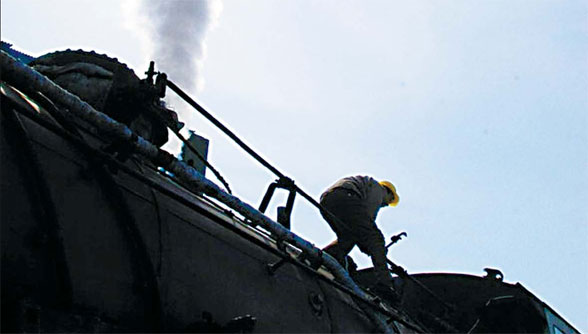
A worker on top of a steam locomotive. Photos by Sun Hai
(China Daily March 14, 2008)