Memories of the city
 0
0 


Siheyuan (Courtyard Dwelling) of Beijing: A Dream Home
|
|
|
Thousands of Siheyuan have been buried under tall buildings in the past decade. |
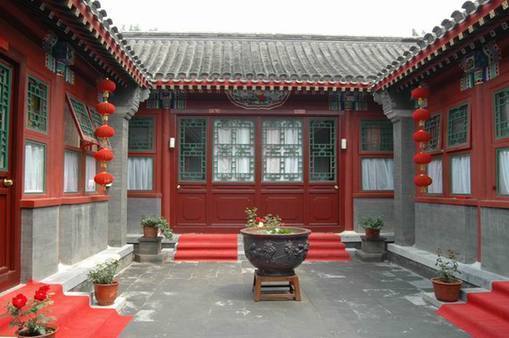
The siheyuan, together with the hutong, is a symbol of the city of Beijing, representing its traditional culture and local customs.
The siheyuan is where Beijing residents have lived for generations. Its enclosed environment has a high privacy level. At the same time, these residences also emphasize the harmony between mankind and Nature. When the gate is closed the courtyard forms an independent environment, where people can contact the sky and earth directly. In the siheyuan, the houses on the four sides all face the yard, where in the summer a canopy is installed as a sunshade. Sometimes there are potted pomegranate trees and a tank of goldfish. Often, four generations of a family live together in a siheyuan. That is the ideal life for most Beijing people.
In recent decades large-scale urban reconstruction has been carried out in Beijing, but the municipal government makes every effort to protect the city's historic and cultural sites, and retain the layout of old Beijing. In this process, some siheyuan have been renovated and modernized; for example, by the Ju'er Hutong Courtyard Housing Project, managed by Professor Wu Liangyong of Tsinghua University. On the basis of retaining the courtyard structure, the single-storey houses were rebuilt to give them two floors, and kitchens, toilets and bathrooms were added. The project won the UN's World Habitat Award. Some of these rebuilt siheyuan have basement where garages were constructed. It is common for people to spare no expense buying and renovating siheyuan in Beijing's ancient imperial lanes. They are building their dream homes, and at the same time inheriting and protecting a valuable tradition of the city.
Shanghai's Shikumen: Life Behind the Door
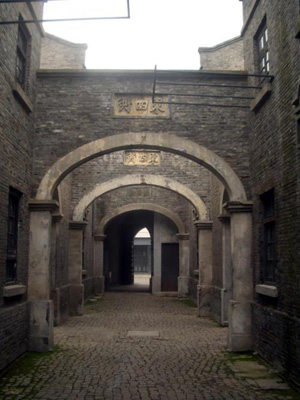 |
Unique to Shanghai, the shikumen (literally, "stone gate") is a stone door frame supporting a heavy wooden double door. A prominent feature of this dark door is a pair of bronze knockers. The shikumen is a cultural blend of elements of Western architecture with traditional Lower Yangtze Chinese architecture. Shikumen residences stand side by side in straight alleys, known as longtang. Shikumen houses are mostly two-story townhouses, having a sloping roof and a dormer window. Each house is circled by a high red-brick wall decorated with Western-style designs. The entrance to each alley is usually surmounted by a traditional Chinese stone arch, the lintel of which carries traditional brick engravings and is roofed with grey tiles. Shanghai's largely Western and modern lifestyle has resulted in a break from the traditional large family homes found in other parts of China, but the longtang shikumen culture has somewhat compensated for this, being brought in by migrants for less extended families.

Go to Forum >>0 Comments


