Millions of Muslims across China Monday celebrated Eid al-Fitr, the festival signaling the end of the Muslim holy month of Ramadan -- a season of fasting and spiritual reflection.
Early Monday, Muslims of different ethnic groups in northwest China's Xinjiang Uygur Autonomous Region and Ningxia Hui Autonomous Region and other Muslim-populated areas donned festive costumes and swarmed into mosques to hear imams preach.
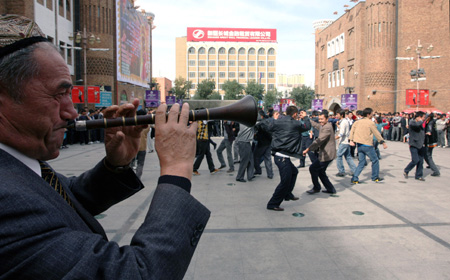
After attending morning prayer, thousands of Muslims of Uygur ethnic group in the Xinjiang regional capital of Urumqi went to a large square of the International Grand Bazaar to sing and dance in joy.
 |
|
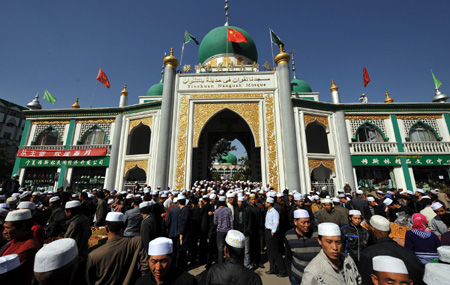
Muslims attend a prayer at Hantengri Mosque in Urumqi, capital of northwest China's Xinjiang Uygur Autonomous Region, Sept. 21, 2009. Millions of Muslims across China celebrated Eid al-Fitr Monday, the festival that signaled the end of the Muslim holy month of Ramadan -- a season of fasting and spiritual reflection. [Xinhua/Shen Qiao]
|
"Ramadan is the most auspicious and noblest month of a year. Nomatter how busy I am, I will join in the celebrations," 32-year-old Aziz said.
Business boomed a few days earlier at bazaars in different cities in Xinjiang, especially in Urumqi, which is still recovering from July's riot that left 197 people dead and more than 1,700 others injured.
|
|
|
A man plays a musical instrument as residents dance to celebrate the Eid al-Fitr in Urumqi, capital of northwest China's Xinjiang Uygur Autonomous Region, Sept. 21, 2009.[Xinhua/Jiang Wenyao]
|
Today I can earn more than double normal days," said restaurateur Maiwutigang. "Nowadays, people's lives are better than in the past, and they do not want to involve themselves in tiring cooking, so many of them would rather come to restaurants for a big dinner and celebration."
Ayixiren, a Muslim of the Kirgiz ethnic group in the city, prepared nuts, cakes, mutton and other food three days ago to greet the arrival of the festival. She also held a ritual at home Sunday night -- according to Kirgiz tradition -- to pay tribute to ancestors, mourn the deceased and pray for a happy future.
"I hope the festivities can disperse the unpleasant feelings left from July's incident and people can retrieve days of stability and prosperity," she said.
Xinjiang has a population of more than 21 million, and more than half of them are Muslims from 10 ethnic groups, such as Uygur, Kirgiz, Kazak and Uzbek.
In Ningxia, the regional government pronounced Monday a public holiday to enable Muslims to visit relatives and friends as Ramadan concluded.
|
|
|
Muslims attend a prayer at a Mosque in Yinchuan, northwest China's Ningxia Hui Autonomous Region, Sept. 21, 2009. [Xinhua/Liu Quanlong]
|
Sumptuous food was prepared at the family of 70-year-old Yang Jingxue, a Muslim of the Hui ethnic group in Yinchuan, regional capital of Ningxia.
"Our religious belief has long been well respected. Some officials from the regional government came to my neighborhood this morning to express congratulations to us," said Yang, a retired doctor.
More than 2.2 million people of the Hui ethnic group live in Ningxia, or about one-third of the total population of the region.
About 12,000 people in the largest Muslim community of Beijing, Niujie Street in the southern part of the city, greeted the fast-breaking festival Monday.
The street was decorated with national flags and red lanterns, and thronged by tens of thousands of Muslims issuing from mosques or standing in long queues to buy Muslim food at outdoor stalls.
An exhibition was unveiled in Beijing Monday to showcase the Niujie Street neighborhood's history, architecture, cultural relics, religious customs and interaction with the outside world.
 |
|
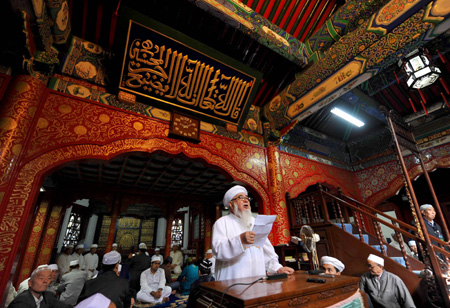
Xue Tianli, the mosque imam, speaks to the Muslims during a prayer in a mosque in Niujie, a compact area inhabited by the Hui nationality, in Beijing, capital of China, Sept. 21, 2009.[Xinhua/Luo Xiaoguang]
|
"I am very happy today, not only for the festival, but also for an opportunity I have been given to participate in the civilian parade for the National Day celebrations at Tian'anmen Square on Oct. 1," said Ma Yanbing, an imam of the Niujie Mosque.
During Ramadan, the ninth month of the year in the Muslim calendar, Muslims refrain from eating, drinking, smoking and sex from sunrise to sunset. But children, elderly people and the weak do not have to observe the fast.
China has now 20 million Muslims, about half of them from the Hui ethnic group.
(Xinhua News Agency September 22, 2009)