Enthralling ancestral home of a Song Dynasty poet
 0 Comment(s)
 Print
Print E-mail Shanghai Daily, July 13, 2016


|
|
|
An archway leads into the Tianping Mountain Scenic Area. |
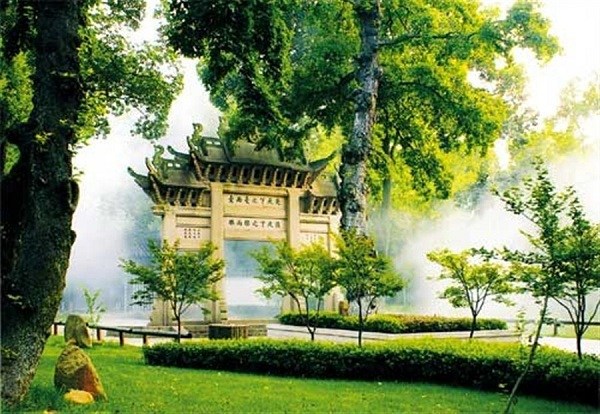
Isolated from the greater part of Suzhou, Tianping Mountain seems almost untouched by the urban growth around it. A site of tranquility, it retains a quintessential aura of Chinese imagery.
Rich in history, the mountain and adjoining gardens southwest of Suzhou are well tended to their original form. Visitors often feel transported back in time to an ancient era of rich culture.
Surrounded by trees, an archway first greets visitors to the mountain. It has been restored to its original look of grandeur and is inscribed with the celebrated philosophical words of famed Chinese poet Fan Zhongyan (989-1052) of the Northern Song Dynasty (960-1127): One should be the first to worry for the future of the state and the last to claim his share of the happiness" (先天之憂而憂,后天下之樂而樂).
Fan had deep historical ties to the property. Tianping Mountain is the home of his ancestral burial grounds.
During the Song Dynasty, Fan was a well-known figure. In 1043, he attempted to initiate a reform of the behavior of officials in the imperial court, but the action offended many of the powerful and wealthy, who persuaded the emperor to oppose the changes.
Still, Fan left many other accomplishments in his legacy. While magistrate of Suzhou, he helped fix a flood problem, opened China's first non-religious charity organization and built schools, one of which is still open today.
The mountain always awes visitors with its impressive array of trees, famous particularly in the autumn for their vibrant foliage. It is considered one of the four best spots in China to view blazing red maples in the fall.
Indeed, autumn is the busiest season at the mountain. During the annual Red Maple Festival, the area is alive with handicrafts markets, music, food stalls and traditional folk performances.
The mountain teems with trees hundreds of years old, accenting the site with not only beauty but also a sense of historical landscape.
The seeds for many of the trees were brought from Fujian Province by the descendants of Fan during the Ming Dynasty (1368-1644). The strong trunks support trees that are sometimes more than 30 meters high. They tower over structures at the site, casting a wide canopy of shade.
Fan isn't the only prominent historical figure to have visited the mountain. Inspired by the beauty, heritage and solitude of the site, countless scholars, poets and officials have come to visit, often leaving verse behind to record their impressions.
Poet Bai Juyi (AD 772-846) wrote the poem "Bai Yun Quan," meaning "spring of white clouds," after a visit to the mountain. It is considered a major work of Chinese literature. The title of the poem lent its name to a spring on the mountainside.
Baiyun Spring is famously clear and was called the most beautiful spring in Suzhou by Lu Yu (AD 733-804) in his monumental book "The Classic of Tea."


