Ancient town of Tangwan: Where time stood still
 0 Comment(s)
 Print
Print E-mail China Daily, April 21, 2016


|
|
|
Old street in Tangwan town, Guixi city, East China's Jiangxi province. (Photo by Zhou Xingzuo/chinadaily.com.cn) |
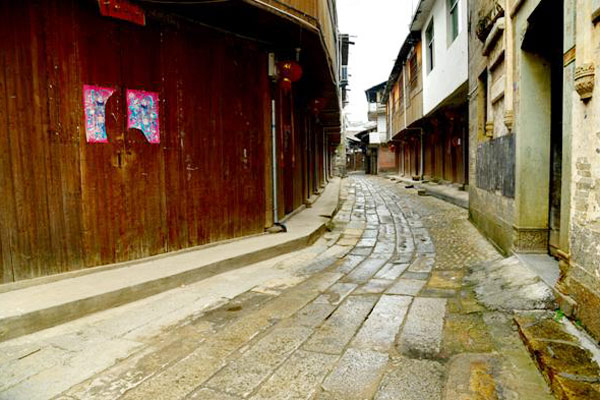
With a history of almost 500 years, the ancient town Tangwan in Guixi city is located on eastern part of East China's Jiangxi province. Unlike other famous ancient towns in China, Tangwan remains an untouched place, with the commercial elements less emphasized.
Tangwan was first built in the middle of Ming Dynasty (1368-1644 AD), on the ancient salt road from Jiangxi to East China's Fujian province. It is said that there used to be hundreds of ponds in the town, with roads connecting each other in twists and turns. That is how the town got its name "Tangwan", which means "winding pond" in Chinese.
Ancient townscape
The old street in Tangwan stretches only 420 meters. Walking in the town of quartzite on the road, you can feel yourself returning to that era.
The long history has endowed the town with many rich and generous cultural relics, making it look like a historic site. The town covers only an area of 2.35 square kilometers but greets you with more than 110 well-preserved traditional unique architectures dating back to late Qing Dynasty (1644-1911AD) as well as the period of early Republic of China along both sides of the road, including old shop, drama stage, little handicraft workshop, residential buildings, and ancient wells, etc.
Since the time of Ming Dynasty, the town has been regarded as the commodities exchange center of southern part of Guixi city. As a well-preserved ancient commercial street of late Qing Dynasty, Tangwan has served as a living material for the study of the Jiangxi province in the aspect of trade as well as culture.
|
|
|
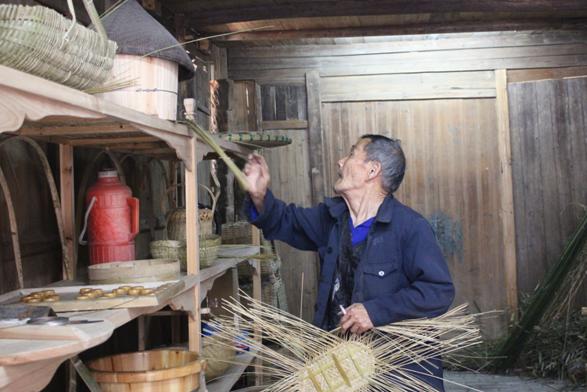
Hu picks bamboo splits from the shelf. (Photo by Zhou Xingzuo/chinadaily.com.cn) |
Handicraft works and Arts
When wandering in the town, traditional handicraft workshops are ubiquitous. The most popular one is a basket workshop called "YuanbaoLan". The baskets are all pure hand-made of bamboo splits, delicate and vivid, looking like the shape of gold ingot, hence the name "Yuanbao" is used.
In the workshop of YuanbaoLan, an elderly folk does his "lifetime business". Hu, a local native, started to learn weaving basket at the age of 14. Nearly half a century later, the young boy is now in his 80s. He is very familiar with the development of YuanbaoLan.
Conversable though he is, Hu carries a deep regret in his voice. He says less and less people are willing to learn the craft of "YuanbaoLan" in these modern times. He is afraid that the craft, which is imbued with deep history, may die off in the near future.
There is an increasing awareness in Hu's heart of the need to pass on his skills as he grows older. "I hope the time for the revival of YuanbaoLan could come soon. I will impart my knowledge and skills without reservation," said Hu.
Guixi city government attaches great importance in protecting traditional culture. An official working in Tangwan said the local government is now preparing the materials for the application of intangible cultural heritage of Jiangxi province.


