Project gives rural schools virtual reach
 0 Comment(s)
 Print
Print E-mail China Daily, November 6, 2012


|
|
|
Hailai Mama, 11, sees a computer for the first time. She quickly learned how to turn it on and off, and use it to read e-books and watch films. |
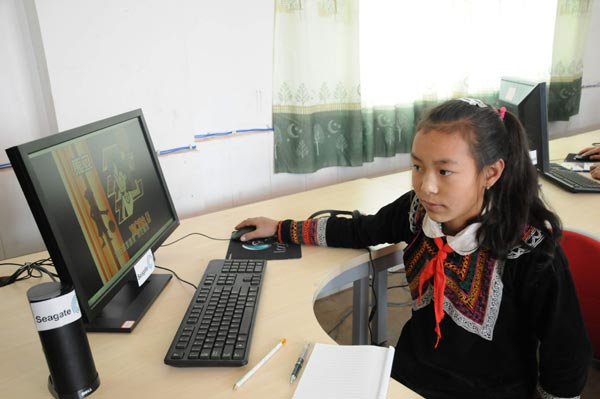
The library has multiple uses, such as multimedia and computer classes, and film showings. Students can read various e-books, including comics and science books, and play educational games. The aim is to broaden their horizons and stir their interest to learn, so that they can know things urban children do.
"The students' Chinese writing has improved, because they can know more about the world beyond the mountains. When I teach them a passage about whales, I show them pictures of whales online. It's very vivid," Ma says.
Ma says the school is rearranging class schedules so that each class gets to use the classroom every week. As there are only 10 computers, it takes two or more weeks for a student to take the turn because the student numbers in the classes range from 27 to 72.
Feng says that compared with traditional libraries, it's convenient to build digital ones because it's cheaper to transport, especially in the mountainous areas, and easy to update online. Moreover, traditional books may become worn out and quickly outdated.
"It's difficult to choose the suitable books for rural children due to regional differences. For example, children from urban cities can go to the aquarium to see a starfish, but the only way for rural children to know about it is from books and pictures," she says.
"Some digital resources may be e-waste in the city but food for the mind for rural children. They can know what the metropolis is like via photos and videos."
The foundation is responsible for the software maintenance, while the facilities, such as computers, are all covered by a government warranty.
Feng says that with Internet access, the libraries can play a greater role, since e-books and other resources can be updated online at any time. However, if there is no Internet access, they must travel to these remote places with a portable hard-disk to update.
She says wireless network cards will be provided for some mountainous areas where it's difficult to provide an Internet network.
"We also plan to organize children to enjoy video chat with their parents who are away working in big cities," she says.
According to Feng, intellectual property rights pose another important issue. The cost of the authorized e-books and videos accounts for more than 40 percent of the project's expense.
In 1989, CYDF started the public service program Project Hope to build schools in impoverished rural areas in China to enable children from poor families to continue their educations.
She says there are more than 18,000 Hope Primary Schools in the country, and the foundation plans to build such libraries for all these schools. "It's a long-term broad project, so we definitely need support from the whole society."

Go to Forum >>0 Comment(s)