Back to a bygone era
 0
0 


Pengjiazhai village
|
|
|
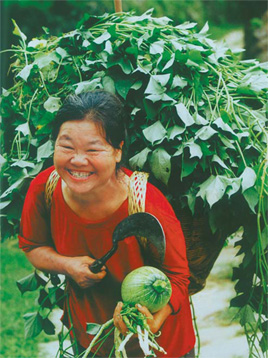
A farmer collects some vegetables from her farm to prepare for a meal. |
Pengjiazhai (Peng's Village) is an ancient Tujia village built on mountain slopes, facing the river. A chained bridge links the village to the outside world.
I spend a night at a cottage on stilts near the bridge. My host, surnamed Peng, says he used to live in the village, like the others. A few years ago, when the local government began to promote tourism, he and his wife took the chance to build a house across the river and launched the only home-stay inn serving Tujia cuisine in the area.
Peng says both his daughters have moved to the Xuan'en county after their marriage, but their grandsons visit them occasionally.
"Come and taste the bacon," calls Peng's wife, slicing the freshly boiled meat. It is truly unique.
She soon covers the table with towel gourd, bean sprout and tomato, which she had just plucked. The delicate egg custard is made from eggs laid by chickens raised at home. Before I realize it, I have finished two big bowls of rice.
After the lavish meal, I walk across the bridge and fields, and into the village. Pengjiazhai is often praised as the most beautiful village of the Tujia people. The praise is well deserved.
All the houses on stilts have intricate wood carvings of red lacquer. The upturned eaves match perfectly the black tiled roof and white ridges.
As I wander in the village, a granny looks up from the lily bulb she is cleaning and smiles at me. Although her wooden house has no paint, the crimson colored couplet from the previous Spring Festival still looks bright on the front gate. She invites me in and brings out tea with fried sunflower seeds.
She says some houses on stilts in the village have three floors, with the pigs, chicken and firewood housed at the ground level, people living in the middle and grain stored on the topmost floor.
I am surprised to find her living room on the second floor decorated with wallpaper and fancy lighting. She says her children, who are working in Zhejiang province, didn't like their old house and insisted on decorating the room like those in the cities.
After saying goodbye to her, I wander around and find more grannies peeling lily bulbs. Two years ago, the local government promoted lily farming in the area, and the flowers have now become a major source of income. Villagers here have a long tradition of growing flowers. Canna, jasmine, balsamine and other flowers add much charm to the quiet village.


