
 0 Comment(s)
 Print
Print E-mail China.org.cn, December 28, 2023


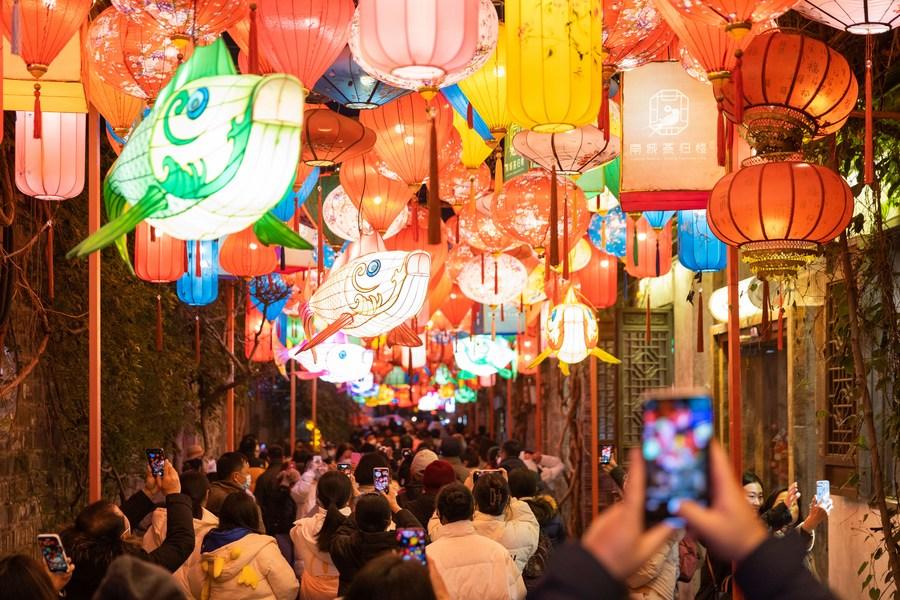
Tourists view lanterns at Laomendong scenic area in Nanjing, east China's Jiangsu province, Jan. 22, 2023. [Photo/Xinhua]
The United Nations recently announced its decision to add the Spring Festival to its list of floating holidays for staff. These holidays are those which employees can take off in addition to the nine official holidays when the U.N. ceases business.
Chinese officials celebrated the move as evidence of Chinese culture's increasing recognition around the world. Ambassador Dai Bing, China's deputy permanent representative to the U.N., said the official recognition of the Spring Festival as a U.N. holiday fully showcases the influential power of Chinese civilization, which will promote exchanges and mutual learning among diverse world cultures and actively embody the U.N.'s values of diverse and inclusive cultural ideals.
From a practical standpoint, it means that anyone working for or at the U.N. can take Lunar New Year off, which will make it easier for them to travel to meet family and observe the holiday. The Spring Festival extends from Feb. 10-20 this year. The most important dates, which are national public holidays in China, are New Year's Eve, New Year's Day, and the second day of the first lunisolar month. Each year, the dates of the Spring Festival on the Gregorian calendar vary, as they are fixed to the Chinese lunar calendar.
As of 2022, the U.N. had over 125,000 employees, not including those employed by the coalitions of each member state. The U.N. recognizes nine official holidays, which are holidays for all staff: New Year's Day, Good Friday, Eid al-Fitr, Memorial Day, Eid al-Adha, Independence Day, American Labor Day (celebrated in early September rather than May 1), Thanksgiving Day and Christmas Day.
They can be generally categorized into Christian holidays (Good Friday and Christmas), Muslim holidays (Eid al-Fitr and Eid al-Adha), and American holidays (Memorial Day, Independence Day and Labor Day) in addition to the international New Year's Day of the Gregorian calendar. The reason so many American holidays are U.N. holidays is that the organization's headquarters are based in New York City.
There are 193 member nations in the U.N., many of which observe a variety of festivals that are not official U.N. holidays, which is why staff there also have a number of days off and the option to take off one of eight floating holidays: Yom Kippur, Vesak Day, Diwali, Gurpurab, Orthodox Christmas, Orthodox Good Friday, Nowruz, and, now, the Spring Festival.
The Spring Festival is one of the biggest festivals in the world. In China alone, over 1.4 billion people observe the holiday. Additionally, there are over a dozen countries that have a population of 1 million or more people of Chinese ancestry. The lunisolar calendar is also used in some other Asian countries, including Vietnam and South Korea, and they celebrate the new year with their own traditions. Foreigners who visit or study in China might also celebrate the Spring Festival by making dumplings or visiting a Chinese restaurant.
I have celebrated the Spring Festival in Beijing, Shanghai, Nanjing and the countryside of Hebei province, as well as the United States. Celebrating in each place has its own charm. In a small town of Hebei, neighbors would walk to the home of the friend I was staying with and bring baijiu rice liquor and food to share. In Beijing and Shanghai, the streets were peaceful and quiet for the only time all year, as many people traveled to visit family members. In Nanjing, there was a large lantern festival arranged on the city wall.
Hopefully this recognition by the U.N. will help those who wish to celebrate the Spring Festival have a more enjoyable experience this February.
Mitchell Blatt is a columnist with China.org.cn. For more information please visit:
http://www.shenbo75.com/opinion/MitchellBlatt.htm
Opinion articles reflect the views of their authors, not necessarily those of China.org.cn.


