
 0 Comment(s)
 Print
Print E-mail China.org.cn, November 30, 2023


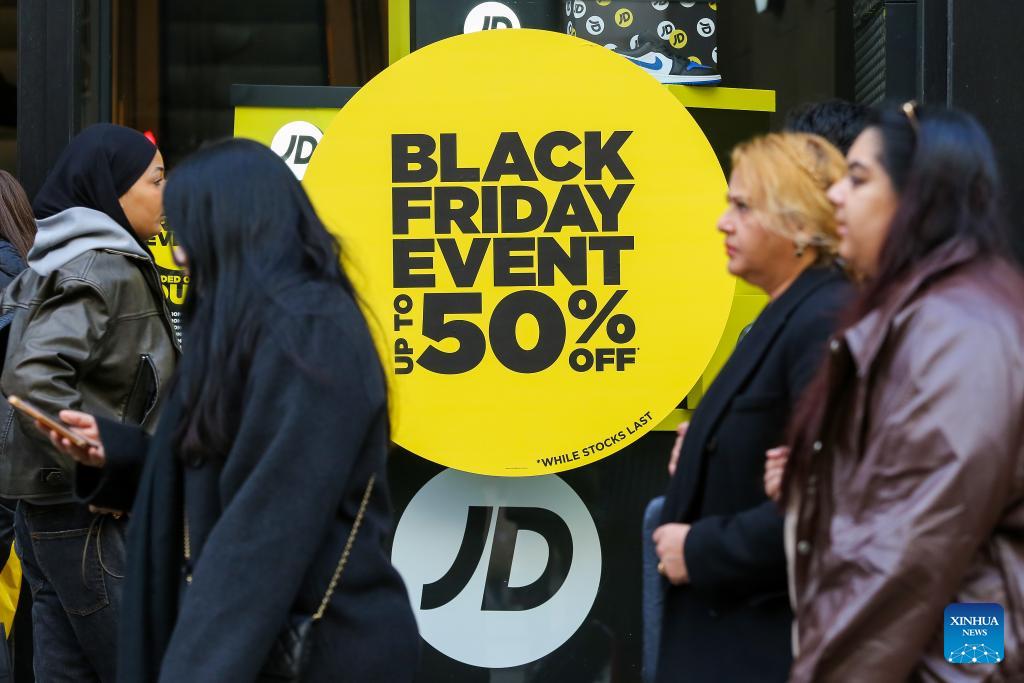
People walk past a sign of Black Friday sales promotion on Oxford Street in London, Britain, Nov. 24, 2023. [Photo/Xinhua]
In 1965, Kwame Nkrumah, who was then president of Ghana, remarked in an essay that old-fashioned colonialism "is no longer feasible" and is "everywhere in retreat." He defined the new model as "neo-colonialism," a model primarily based on monetary and economic policy. The great powers would now use loans and trade deals to exercise leverage over the formerly colonized nations.
Another tool in the neo-colonialist arsenal is cultural imperialism. Herbert Schiller, an American sociological scholar active around the same time period as Nkrumah, defined cultural imperialism as Uncle Sam's "coercive and persuasive agencies, and their capacity to promote and universalize an American 'way of life' in other countries without any reciprocation of influence."
Now, 58 years after Nkrumah's seminal essay, Jumia, Africa's largest e-commerce website with offices in Ghana, has just run a "Black Friday" promotion for three weeks. The campaign began on Nov. 3, 20 days before American Thanksgiving, and ended on Nov. 24, the day after Thanksgiving.
There have been "flash sales" three times a day every day of the sale. Consumers are supposed to stay hooked to their phones or refresh the shopping page on their desktop browsers if they want to take advantage of "irresistible discounts" during the shopping frenzy.
Black Friday, the shopping day tied to Thanksgiving, the celebration of the harvest and cooperation with Native Americans, was once a signature event of American consumerism. Nowadays, many retailers around the world have adopted such shopping frenzies.
Supposedly, cops in Philadelphia started referring to the Friday after Thanksgiving, which always takes place on a Thursday, as "Black Friday" because of the traffic and chaos that ensued as shoppers got a jump on shopping. Eventually, retailers took note of consumers' shopping habits and started offering special deals on Black Friday. They rebranded it as "the day the books went from red ink (indicating a loss) to black ink (profitability)."
It might sound like a win-win for companies to start making money and for consumers to get something nice at a discounted price. But, in reality, shoppers would wake up early and sleep outside of stores and then stampede at the moment the doors opened. Rather than enjoying their holiday respite from work and stress, they just became more stressed.
As such, retail workers have to work extra hours. In the 2010s, Walmart was open on Thanksgiving Day. Since 2020, however, Walmart has not opened on Thanksgiving, reflecting a shift in marketing. After all, 61% percent of Black Friday sales are online, so there's no point in having the brick store open. But that doesn't do away with the harmful attitudes and values contained within Black Friday.
People should buy things when they need them, not when they are told to do so by advertising companies and big businesses. One of the biggest Black Friday items on sale in America is television sets, even though 93% of Americans already own one set or more. Television is not a fulfilling enough activity to make it necessary to buy the newest set with some incremental improvements every year.
Capital always needs to expand, which therefore partially leads to the promotion of the worship of goods. American companies have been pushing it on the world with their own promotions abroad and their relentless media blitz. But some companies promoting Black Friday sales are local companies that just want to get in on the money.
During holidays, perhaps what we really need is just being together with family and friends instead of impulsive shopping.
Mitchell Blatt is a columnist with China.org.cn. For more information please visit:
http://www.shenbo75.com/opinion/MitchellBlatt.htm
Opinion articles reflect the views of their authors, not necessarily those of China.org.cn.


