Developing China's 'supply side'
- By John Ross
 0 Comment(s)
 Print
Print E-mail China.org.cn, December 31, 2015


|
|
|
Weight training [By Jiao Haiyang/China.org.cn] |
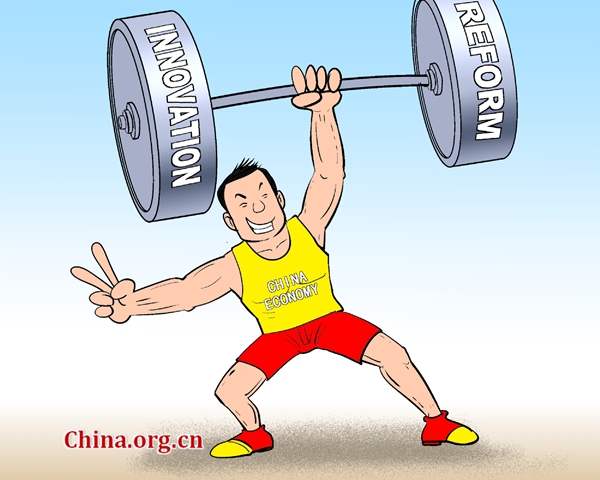
China recently made two economic decisions. First, the 13th Five Year Plan from 2016-2020 should achieve "at least 6.5% annual growth for China to become 'moderately prosperous" -- close to the World Bank's criteria for an "advanced economy." Second, December's Central Economic Work Conference announced that China's policy will concentrate on the economy's "supply side."
This latter decision is welcome. Primary concentration on the economy's "demand" side is misapplied in either China's Marxist or a "Western" economic framework. Switching focus to the supply side introduces greater precision into economic policymaking as specific numbers must be stated to calculate the requirements for at least 6.5% growth.
There are only two fundamental frameworks of analysis of the economy's supply.
? The first is "growth accounting," developed by U.S. Nobel Prize winner Robert Solow, which is the framework of "Western economics." This analyses the economy's "supply side" in terms of three inputs of capital, labour and total factor productivity (TFP) -- TFP being all growth sources not only due to inputs of capital and labour.
? The second is Marx's, the official basis for China's policy, which analyses the economy in terms of capital, labour and surplus value -- the latter being numerically equal to profits, rent and interest.
For present purposes, these may be reduced to one framework as both Solow and Marx in "growth accounting" are concerned with overall input-output levels and their other differences do not affect this.
The study of economic statistics identifies that "supply side" Inputs have very different weights. Therefore, to achieve "moderate prosperity" not only the supply side's "algebra" but its "arithmetic" must be considered. Given that China's aim is to achieve moderately prosperous and even advanced economic status, the driving forces of the world's most advanced economy, the United States, will first be considered and then China's current differences to the United States analysed. The contrast indicates policies China must pursue to become an advanced economy. Figure 1 below therefore shows the sources of U.S. economic growth and these will be analysed in descending order to importance.
The United States, as with all economies, has two capital inputs, the first of which is "Intermediate products" -- one industry's outputs used as another's inputs (e.g. outputs of steering wheel producers provide inputs into the automobile industry). Financially, as Charles Jones noted for the U.S. National Bureau of Economic Research, "intermediate goods are just another form of capital, albeit one that depreciates fully in production" -- they are "circulating capital." Increase in Intermediate products indicates a growing division of labour and accounts for 52% of output increases by U.S. economic sectors -- the largest growth source.
The second capital input is "fixed investment," or the means of production depreciating over numerous production cycles. This constitutes 24% of increases in U.S. output.
Growth in labour inputs account for 15% of U.S. output increases -- this growth being due to both increase in total time worked ("labour quantity") and improvements in training and education ("labour quality").


