China's inevitable path to same-sex marriage
- By Ember Swift
 0 Comment(s)
 Print
Print E-mail China.org.cn, July 25, 2015


|
|
|
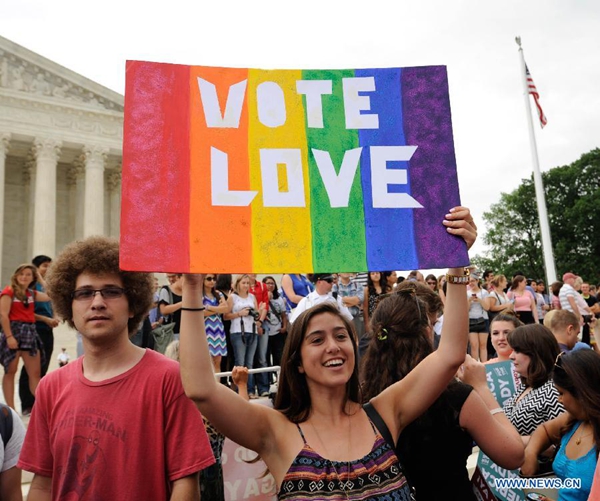
People in support of same-sex marriage rally outside the Supreme Court in Washington D.C., the United States, June 26, 2015. The U.S. Supreme Court on Friday ruled that there is a right to same-sex marriage in all 50 states across the country. (Xinhua) |
Conversely, in other regions in Asia, gay pride parades and rallies for gay rights such as equal marriage are not absent, although they are hardly commonplace. That's because most Asian cultures are similarly unexplicit about sexuality, thus leaving many LGBTQ communities in places like Thailand or Indonesia in a precarious position in which they are either tolerated or loosely acknowledged, but only on the fringes; they are not integrated into society. This, surely, is not a solution for an egalitarian, harmonious society.
Similarly, I fear that the reality of achieving marriage equality in China is a hope that may be as far away in months as America is in miles. This is a cultural chasm. Marriage in China is still not considered a choice; it is more a filial duty. While Chinese youth can now choose their mates, for the most part, modern matchmaking is still very common. Extensive, complex requirements must be met and a potential mate's "circumstances" are heavily discussed by many more parties than just the aspiring bride and groom. Do they own property? Are they educated? Do they have other assets? How is the health of their parents and older relatives? How old are they? What is their profession? What is their social status and connections?
Because marriage is such a family-oriented project, the Chinese gay community still sees a high number of marriages of convenience between gay men and lesbian women. Such arrangements both satisfy extended family's desires for progeny (assuming the two married people are willing to procreate together) and enable the married people to live discreet lives of freedom outside of their bonds of false heterosexual marriage. To be fair, if such decisions are made between consenting adults, who are we as bystanders to argue or dispute their validity?
To a Westerner, however, such unions belie the greater issue, which is the inability to be oneself, to be out and proud, and to be a freely expressive and respected member of society who is open about one's sexuality. There, again, Western thinking emerges. In a culture in which sexuality is meant to remain behind closed doors, why be publicly proud of something that others aren't supposed to be seeing in the first place?
Furthermore, the one-child policy has placed enormous pressures on this generation to continue the lineage of Chinese families. With the recent loosening of the one-child policy regulations to allow an only child who marries another only child to have two children rather than one, there is hope that this pressure will lessen. Nevertheless, Chinese LGBTQ youth of marrying age (namely under thirty) are faced with the heart-wrenchingly impossible quandary of whether to be true to themselves or true to their family obligations. We must suspend our Western judgments in light of the cultural complexities that we can only glimpse as outsiders.


