China balances Silk Road strategy in Latin America
- By Tim Collard
 0 Comment(s)
 Print
Print E-mail China.org.cn, July 7, 2015


|
|
|
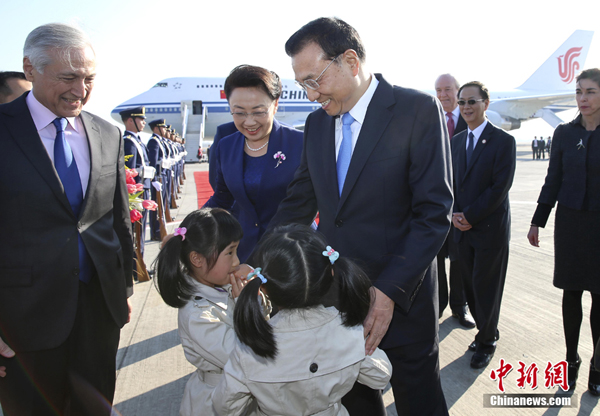
Chinese Premier Li Keqiang arrived in Santiago Sunday for an official visit to Chile, the first South American country with which China forged diplomatic ties and also the first Latin American nation with which China signed a free trade agreement. [Photo/Chinanews.com] |
Though trade between Asia and Latin America has changed significantly over the centuries, it is surely relevant to call to mind this development now that a multi-polar world economic order is emerging in the 21st century. China may be putting the bulk of its efforts into establishing infrastructural links with its immediate neighbors, many of whom have serious problems with historically-related backwardness. However, China also knows that it is always dangerous to become too dependent on one region, where unpredictable factors like political or natural disasters can always render all one's calculations useless. A balanced approach in which no part of the world is neglected is a necessity for a great power in the modern era.
Li Keqiang's Latin American tour was a follow-up to President Xi Jinping's statement in January that China would pledge US$250 billion of direct investment to the region over the next 10 years amid hopes that annual bilateral trade will reach US$500 billion. This will be rather more difficult now than in the days when South America possessed more or less unlimited money, but even at such a distance, China can play one of its strongest cards: that of infrastructure. Premier Li, who visited both the east and west coasts of the continent, announced that a feasibility study will be undertaken into the possibility of establishing a rail link across the Andes from Brazil to Peru. This would be built on the usual Chinese terms - making use of not only Chinese finance but also Chinese labor and equipment - but it could still transform the internal trade of the South American continent.
The real difficulty lies in establishing balanced trade between China and Latin American economies. Latin America's main significance in the world's economy is as a source of commodities and raw materials, and the continent is currently not well placed to export higher-value goods. It is hoped that Chinese investment can do something to redress this imbalance, as any trade relationship must provide solid mutual benefits for long-term success. But there also needs to be more balancing Latin American investment in China, as well as a reduction of barriers to both trade and investment between the two regions.
So this relationship is a work in progress. One of the major driving factors behind it is that both China and Latin American countries are keen to show that they are not overly dependent on the United States and that a multipolar global economy is a sustainable reality. But there is a solid historical background to show that this relationship - despite the huge distances involved - can still be a major component of a geographically balanced world economy.
The writer is a columnist with China.org.cn. For more information please visit: http://www.shenbo75.com/opinion/timcollard.htm
Opinion articles reflect the views of their authors, not necessarily those of China.org.cn


