Athens-Moscow: an (un)orthodox alliance?
- By Giovanni Vimercati
 0 Comment(s)
 Print
Print E-mail China.org.cn, April 15, 2015


|
|
|
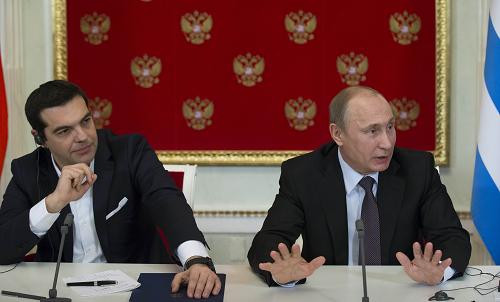
Russian President Vladimir Putin (R) and Greek Prime Minister Alexis Tsipras attend a joint press conference after a signing ceremony at the Kremlin in Moscow on April 8, 2015. [Xinhua photo] |
Shortly before Greece's Prime Minister Alexis Tsipras met Vladimir Putin in Moscow on his first official visit to Russia, the Financial Times published an article reporting the overtly anti-democratic suggestion that many officials, including some eurozone finance ministers, have put forward for the resolution of the problems in Greece. If a bailout agreement is to be made possible, the unnamed officials stated, Tsipras will have to ditch the far-left component of his coalition and opt for a re-alignment with the center-left forces of Pasok. If the word "democracy" hadn't been already emptied of its essential meaning, such a statement – one that blatantly proposes ignoring the will of the Greek electorate – would have triggered some sort of reaction. But in a continent where the distinction between financial and political forces is a very fine line, the very idea that a nation's political sovereignty can be disrupted at will is apparently not that outlandish.
Far from surrendering to the institutional blackmail of the Troika, Alexis Tsipras, while in Moscow, has reiterated that his country is not a "debt colony" and remains a "sovereign" nation. He also took the opportunity to stress the many aspects that link Greece to Russia, from their shared religion, Orthodox Christianity, to the common fight against fascism that ideologically united them 70 years ago. Yet behind the ceremonious formalities that choreograph every diplomatic junket, a geopolitical awareness on the side of Greece regarding its strategic position in the Mediterranean can be clearly deduced. Neither Athens nor Moscow wants Greece to break away from NATO or the European Union. Quite the contrary, Greece could function as a conciliatory bridge, both political and economic, between Europe and Russia at a time when the relationship between these two powers is rather tense.
In an attempt to curb the Russophobic hysteria that agitates the waters of the Atlantic, Tsipras has in fact declared that the sanctions imposed on Russia are "a road to nowhere," a declaration not devoid of a certain self-interest yet much-needed in a public debate where certain positions are de facto unacceptable. Unsurprisingly, and unlike with his European counterparts, Tsipras found in Putin a most receptive interlocutor. The Russian president warmly welcomed Athens' invitation to step up economic cooperation between the two countries. Furthermore, Greece will take part in the Turkish Stream project with its own pipeline that will bring Russian gas from the Turkish border to Macedonia, from whence it will continue to Hungary via Serbia.


