Xi's Asia-Pacific blueprint
- By An Gang
 0 Comment(s)
 Print
Print E-mail China.org.cn, March 11, 2015


When Chinese President Xi Jinping first unveiled the Chinese dream concept in 2012, some observers interpreted his idea as a vague attempt to foster unity among the Chinese people. Two years later, Xi's governing style has been widely recognized for making fruitful achievements in economic reform, anti-corruption and international relations. Few would still claim that the Chinese dream is empty rhetoric, as the reality behind the vision takes shape day by day.
|
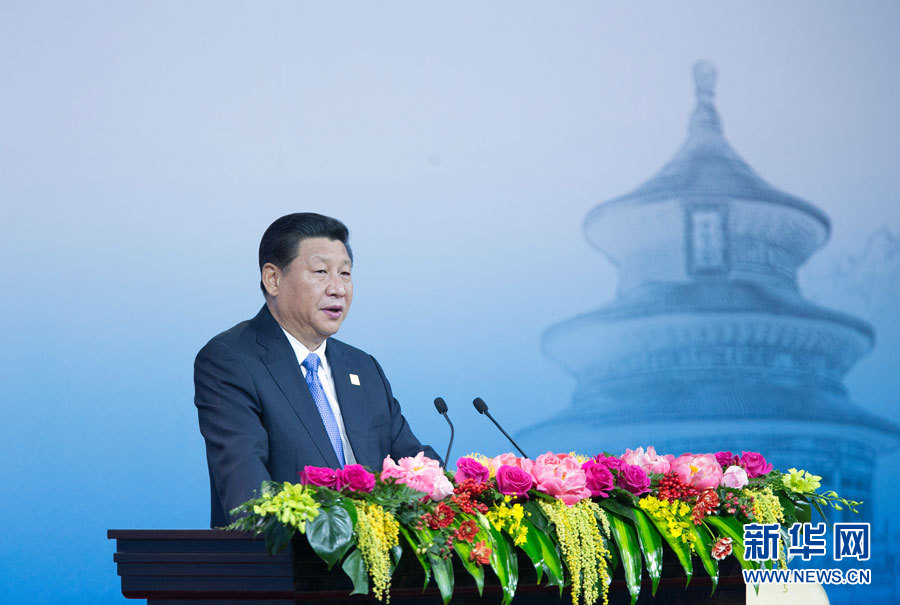
Chinese President Xi Jinping delivers a keynote speech at the opening ceremony of the 2014 Asia-Pacific Economic Cooperation (APEC) CEO Summit in Beijing, capital of China, Nov. 9, 2014. [Xinhua/Ju Peng] |
The Chinese dream is not limited to the Chinese people themselves in isolation from the world. The Chinese leader envisions the further integration and in-depth cooperation of the global community as necessary conditions for achieving the Chinese dream in the modern era. In the past two years, President Xi has visited more than 30 countries covering five continents, stressing repeatedly through contact with local people that the Chinese dream "will not only benefit the Chinese people but also will benefit the people of the whole world."
A dream for the Asia-Pacific
China operates under several geopolitical identities. For one, it is a country of the Asia-Pacific—a region that is particularly important for Chinese diplomacy. The Chinese economy, now the second largest in the world, accounts for one fourth of the Asia-Pacific economy. Eight of China's top 10 trading partners are located in the region. When the late Chinese leader Deng Xiaoping adopted the reform and opening-up policy 36 years ago, Asia-Pacific countries including Japan, Thailand, Singapore and the United States were among Deng's first state visits due to their significance for China's economic expansion. The interconnection between the Chinese dream and the world also begins with the dynamic region.
In November 2014, when President Xi addressed the opening ceremony of the Asia-Pacific Economic Cooperation CEO Summit in Beijing, he called on regional countries to jointly build a future-oriented Asia-Pacific partnership, saying, "We are duty-bound to create and fulfill an Asia-Pacific dream for our people."
Xi further explained that the idea was to act in the spirit of the Asia-Pacific community out of a sense of shared destinies, following the trends of peace, development and mutually beneficial cooperation. It is about staying ahead of global development and making greater contributions to the well-being of mankind—a path to economic vibrancy, free trade and investment facilitation, better roads, and closer people-to-people exchanges.
Xi's Asia-Pacific dream is not simply a matter of public diplomacy; rather, it is a systematic strategic project with regional economic integration as its platform. During the Beijing APEC meeting last November, Xi announced the Free Trade Area of the Asia-Pacific roadmap, which has gained support from more than 20 countries. China has already set up a $10-billion Silk Road Fund to promote infrastructure construction and industrial expansion in countries along the Silk Road Economic Belt and the 21st Century Maritime Silk Road. China has also championed the establishment of the Asian Infrastructure Investment Bank, providing half of the initial capital of $100 billion to boost regional development. Currency diplomacy is another active field, as the Chinese yuan has now become the second most commonly used currency in foreign trade next to the U.S. dollar. One third of China's bilateral currency swap agreements and two thirds of its free trade agreements were made with Asia-Pacific countries.
China's regional economic plan is an extension of its strategic revitalization. This plan does not entail hegemonic ambitions through military expansion. China has no such intention, and the complexity and diversity of the regional situation in the Asia-Pacific bars the emergence of any would-be hegemonic force.


