Strengthening counter-terrorism measures
- By Eugene CLARK and Xianshu Wu
 0 Comment(s)
 Print
Print E-mail China.org.cn, March 7, 2015


|
|
|
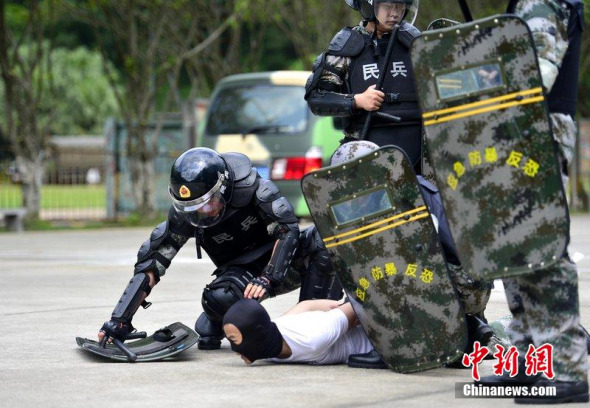
China's first counter-terrorism militia at street level was unveiled to the public in Shenzhen in May, 2014. [Photo/Chinanews.com] |
A fundamental responsibility of the government is to protect the security of its citizens. In the current era of violent extremism, it has moved center stage in the agenda of many governments, and China is no exception.
In China, terrorism, national separatism and religious extremism have spread rapidly through assassination, kidnapping and bombing.
The year 2014 witnessed several terrorist incidents, including an attack on a team of patrol police in Wushi in Xinjiang's Aksu Prefecture on February 14, an attack at a Kunming railway station on March 1, an attack at the Urumqi South railway station on April 30, a knife attack at a Guangzhou railway station on May 6, bombings in an Urumqi marketplace on May 22, and the Xinjiang Shache explosion on July 28.
This has emphasized the need for enhanced counter-terrorism measures.
Presently, each region has its anti-terrorism agency, but the problem is that responsibilities for preventing and combating terrorists have not been clearly delineated and a legal infrastructure supporting a national strategy is not in place.
On October 29, 2011, the 23rd meeting of the Standing Committee of the 11th National People's Congress (NPC) passed the Decision on Strengthening Anti-Terrorism Work, the first step towards development of anti-terrorism legislation.
On February 25 this year, the draft anti-terrorism law underwent second review by the 13th meeting of the 12th NPC Standing Committee.
It defines terrorism as "any speech or activity that, by means of violence, sabotage or threat, generates social panic, undermines public security, and menaces government departments or international organizations."
One important new development is that the draft also provides better aerospace control to guard against drone attacks. It also clarifies the power of army and armed police to exercise on-site command, before security personnel arrive at the scene of a terrorist attack.
Regarding identification of terrorist organizations and personnel, the relevant departments of the State Council and provincial anti-terrorism institutions take the responsibility for recognition. Moreover, the courts have the right to identify terrorist organizations and personnel directly in the process of a criminal trial in accordance with the law.
While laws are important in fighting terrorism, China also recognizes the need to strike an appropriate balance by emphasizing that human rights must also be protected. Accordingly, the draft law stresses that government authorities can only acquire citizens' information accessed by telecom and Internet technology, by implementing strict approval procedures.
All technical reconnaissance measures must be in accordance with the law and regulations. The materials obtained can only be used in response to investigation, prosecution and trial against terrorism crimes. Questioning, inspection, and court summons procedures should be carried out in accordance with the relevant laws and regulations, and court approval must be obtained to inquire into, seal up, seize or freeze assets.


