The TPP's economic mission and ultimate aim
- By Zhang Jingwei
 0 Comment(s)
 Print
Print E-mail China.org.cn, November 7, 2014


In order to break the curse, economic and trade relations between China and the United States should be stressed. Unfortunately, the TPP intentionally ignored China. It can be said that the United States, and even Japan, wants to stop China's strong trade growth and increase China's frustration in regional economic and trade cooperation by means of the TPP system. Both TPP and the Transatlantic Trade and Investment Partnership (TTIP) are the deceleration strip for the United States to block China's influence in the global economy and trade.
|
|
|
Outlying party [By Jiao Haiyang/China.org.cn] |
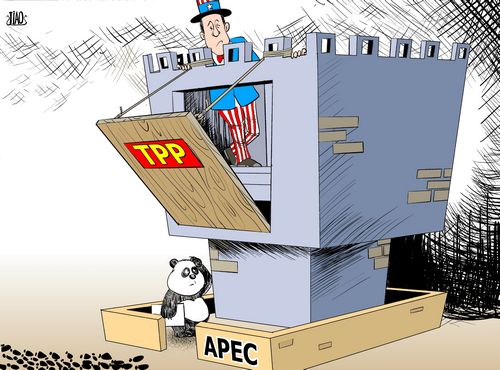
So, the economic mission of the TPP negotiations is just the surface presentation while restraining China in the geopolitics is the final destination.
But looking at the negotiation progress, Japan and South Korea are slowing down TPP. The differences lie in market access. The problem between the United States and Japan is that the former insists that the latter lower the barrier for agricultural product imports while the latter hopes to protect the interests of its domestic pork, beef, dairy and sugar manufacturers. Shinzo Abe's government may always follow the United States' advice, but it dares not go against Japanese farmers as well. The difficulties in the negotiations between the United States and the South Korea come from the fact that although the United States-Korea Free Trade Agreement (KORUS) was signed two years ago, the United States does not think that the South Korean market is open enough to meet the U.S. requirement. If these existing problems in bilateral free trade cannot be resolved, the TPP negotiations between the two countries will face obstacles.
Southeast Asian countries, of course, are anticipating the TPP optimistically. However, at the same time, as they used to benefitting from the games between big powers, they do not want to choose sides between China or the United States - in either geopolitics or economic and trade cooperation. Southeastern Asian countries, including Australia, are significant mutual trade partners with China. Besides, apart from Indonesia, almost all the Southeastern Asian countries have joined the AIIB. South Korea and Australia, although they are hesitating, also indicated that they would join at the proper time.
The Asia-Pacific and even the global multi-lateral trade mechanism will experience lots of problems which will cause regional turbulence if either China or the United States is absent. A TPP without China could worsen the situation - losing the "lubrication" of economic and trade relations between China and the United States and bringing forward the risk of losing game control in the Asia-Pacific region. This will not be good for either country. Nor would it be good for the region.
The writer is a researcher with the Chahar Institute.
The article was translated by Li Bin. Its original version was published in Chinese.
Opinion articles reflect the views of their authors, not necessarily those of China.org.cn.


