Scottish independence: an imperial implosion?
- By Heiko Khoo
 0 Comment(s)
 Print
Print E-mail China.org.cn, September 18, 2014


The referendum on Scottish independence on Sept. 18 has thrown the British political elite into utter panic. A few months ago it appeared that this referendum would produce a close victory for the campaign to keep the United Kingdom (UK) together. But now colossal concealed tensions have been unleashed. They strike at the heart of historical knots that bind together the modern world. A vote for independence will have a profound impact far beyond this "Sceptered Isle."
|
|
|
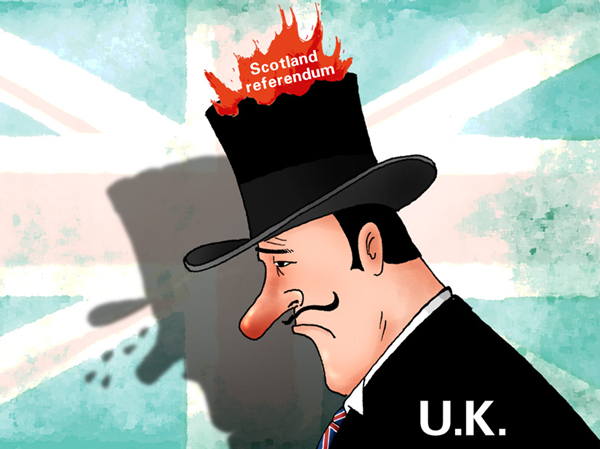
A lot on his mind [By Zhai Haijun/China.org.cn] |
Scotland has been united with England since 1707: three centuries in which Britain became the pioneering epicenter of industrial capitalism. The U.K. developed into the largest empire in world history by 1945. For two hundred years it plundered the planet, reshaped life, the economy and society, everywhere that its armies, missionaries, traders, and civil servants set foot. The demise of the British Empire after World War II was managed in a way that retained a significant cultural, political and economic footprint in many former colonies. Often these newly independent countries retained institutional forms that emulated British institutions and used the English as the language of government, law and politics. The ruling class of many former British colonies emulated the tastes of English colonists, with their tea and scones, their penchant for cricket, lawn tennis, beer and whiskey. The decline and fall of the British Empire corresponded with a major shift in the class balance of forces inside Britain as a leftward shift in politics gave birth to a first rate welfare state; providing free and universal health care on demand, free education at all levels, generous unemployment, social security and pensions provision.
So, when the welfare state consensus collapsed at the end of the 1970s, and the Conservative Party under Margaret Thatcher declared war on the rights of the working class, public industries and public property were sold off and regional disparities came to mirror historical, cultural and national differences. A north-south economic and political divide became entrenched, the north voted Labour, the south, Conservative. This division was even stronger in Scotland. Under Tony Blair's Labour government Scotland was granted considerable autonomy, which the Scottish Nationalist Party (SNP) used to good effect by maintaining free education and free medicine. This took place at a time when the rest of the U.K. saw these rights taken away and the Labour Party adopting political and economic policies to the right of the SNP. In this way, the national question became anchored in fundamental material differences in social politics. The present Conservative led coalition seeks to sweep away the public provision of social, welfare and health provision. Therefore, to many Scottish voters, it appears as if a vote for the independence of Scotland can build on, and advance, this more progressive political and social agenda.


