Reality of China's aging society
- By Grayson Clarke
 0 Comment(s)
 Print
Print E-mail China Daily, December 19, 2013


China has changed beyond recognition in the past 30 years. Therefore, the challenge for the Third Plenary Session of the 18th Communist Party of China Central Committee was not only to recognize those changes, but also to set a policy course that would enable the country to get ahead of its challenges. In terms of the new policy directions that have emerged in the final report of the plenum, the general response has been "so far, so good". Whether these directions can be translated swiftly into action remains a major issue.
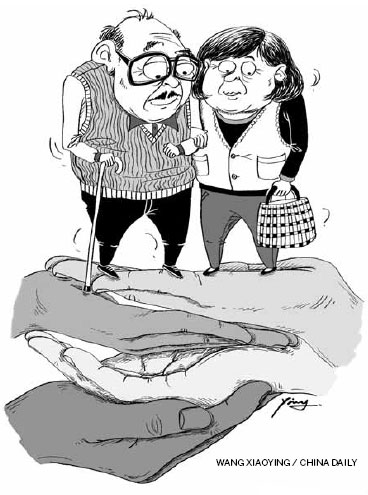 The plenum was all about responding to the need to change, and no bigger change will take place in the next two decades than in demographics, in the acceleration of the migration of people to cities and the remorseless march of the aging society. For that reason, a significant focus of the plenum's deliberations was on providing common rights to all citizens.
The focus of urbanization will be the reform of the hukou (household registration) system and unifying the rights and entitlements to healthcare and social security. The emphasis in the demographic change will be to try and make the transition to an aging society smooth while, at the same time, pushing forward the involvement of the State in social care and well-being of senior citizens.
A look at the plenum's report will reveal the potential of these policies to affect the pace and have an impact on demographic changes. At the base of the demographic pyramid, the decision to change the family planning policy - allowing couples one of whom is a single child to have two children - is a welcome but overdue change. Whether it will have a significant impact on society, given the rising cost of bringing up children, remains to be seen, although the evidence from other countries in East Asia such as the Republic of Korea and Japan suggests that having just one child is often the private choice of couples and is not dependent on public policy. But for rural families and more affluent urban couples in the 25-to-34-year age group, it may have some impact.
More significant in terms of creating a larger working population is the decision to look at increasing the retirement age. Hu Xiaoyi, deputy minister of Human Resources and Social Security, has said that China will raise the retirement age in progressive steps.
As China becomes a more knowledge-based economy, the skills of more mature workers may be necessary to maintain the country's competitive edge. But as raising the retirement age in Europe has shown, such changes are difficult to "sell" to the public. They need to be phased in over a long period of time and linked to financial incentives such as higher deferred pension benefits and lower social security costs.


