Decoding the Middle-Income Trap
- By Danny Quah
 0 Comment(s)
 Print
Print E-mail China.org.cn, July 20, 2013


The World Bank provides another:
 |
|
World Bank, 2012. China 2030: Building a Modern, Harmonious, and Creative High-Income Society. |
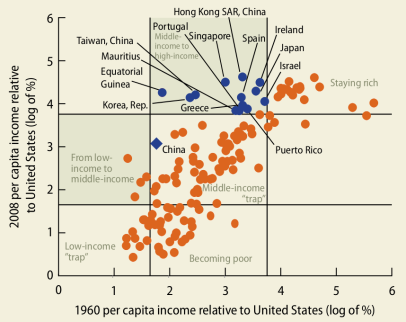
Of course, this World Bank evidence is consistent with and elaborates usefully on the ADB example. Here, the 45-degree line shows economies which, by 2008, remained in the same position relative to the U.S. as they had been in 1960. Thus, although those economies grew, they did so only at the same pace as the most advanced economy. These economies were not helped by the advantage of backwardness, the picking of low-hanging fruit, the catch up that was supposed to happen.
Economies appearing below the 45-degree line did even worse -- they fell even further behind, even when they had started out relatively poor and could ill afford to regress. The World Bank report says this Figure shows how if one divides up relative incomes, not unreasonably, into groups of low, middle, and high, then by 2008 only 13 economies had managed to break out of the Middle-Income Trap from the 101 which were already middle-income in 1960.
The BBC's economics editor Stephanie Flanders read between the lines of the World Bank's report to tease out what the World Bank would not explicitly announce, namely that China cannot hope to evade the Middle-Income Trap without becoming "more like us."
While considerable evidence continues to accumulate on the Middle-Income Trap (such as Eichengreen, Park, and Shin, 2013), let me further analyse this chart. The 13 successes which have left behind the other middle income economies fall into three groups:
1. Five East Asian, Confucian tradition economies: Hong Kong China, Japan, Korea, Singapore, and Taiwan China;
2. Four PIGS economies: Portugal, Ireland, Greece, and Spain;
3. Four quite varied economies: Equatorial Guinea, Israel, Mauritius, Puerto Rico
For policy-makers who are seeking to tease valuable lessons out of the escapees, Group 2, the PIGS economies, is almost surely not where one would want to go. For Group 3, perhaps other observers will be able to find useful commonality; I cannot.
As far as Group 1 is concerned, things actually look pretty good for China.
The author is a columnist with China.org.cn. For more information please visit: http://www.shenbo75.com/opinion/dannyquah.htm
Opinion articles reflect the views of their authors, not necessarily those of China.org.cn.


