Obama's Middle East woes
- By Zhao Jinglun
 0 Comment(s)
 Print
Print E-mail China.org.cn, December 5, 2012


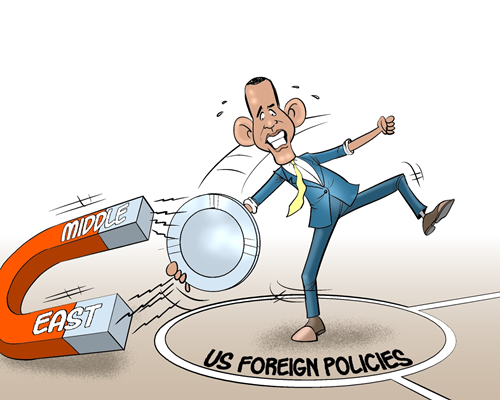
The Obama administration has decided to pivot toward Asia, but the real big drama is being played out in the Middle East. One-fifth of the world's petroleum exports flow out of the region. And rising political Islam is challenging United States dominance. With conflicts flaring up all over the region, there is no way Obama can ignore the Middle East.
|
|
|
Irresistible [By Jiao Haiyang/China.org.cn] |
On Nov. 29, the UN General Assembly voted overwhelmingly to give Palestine non-member Observer status. The vote was 138-9 with 41 abstentions. Only the United States, Israel, Canada, the Czech Republic and some Pacific Islands voted no. America's European allies France, Italy, Spain, Portugal, Ireland and Sweden voted for the new status. Even Germany, reluctant to buck Israel due to the terrors of the Holocaust, voted to abstain rather than to oppose the measure.
The vote was a big defeat for the United States and Israel. Israeli Prime Minister Benjamin Netanyahu declared the Palestinian new status meaningless and refused to recognize the resolution. He then went a step further, announcing that Israel is planning to construct Jewish settlements in a sensitive area east of Jerusalem known as E1 and the West Bank that would effectively bisect the West Bank and doom plans to create a contiguous Palestinian state.
Netanyahu's move came as a rude shock to the Obama administration. The State Department deplored the announcement but did nothing else.
Is Palestine's new status "meaningless"? Hardly. The Palestinians now have the power to take Netanyahu and others to the International Criminal Court and accuse them of war crimes and crime against humanity. They can also provoke resolutions and statements from various UN bodies and committees and cause Europeans to boycott Israeli settler-made goods (this would be similar to the demands of the youth wing of the Swedish Social Democratic Party that Swedes boycott all Israeli settler-made goods). Also, more European countries will likely elevate their Palestinian missions to full embassy status.
Another hot spot is, of course, Syria, where all hell has broken loose. Some 40,000 men, women and children have died in the civil war which erupted in March 2011. President Bashar al-Assad has denied calling the conflict a "civil war", instead referring to it as a fight against terrorists. The US wants Assad out, so as to deprive Iran of a key ally. But it worries about what might come after al-Assad's fall.
The Syrian rebels including not just democracy advocates represent a wide range of allegiances, from mild Islamists to Al Qaeda and its allies. Aided by the West, Turkey and some Gulf states, they have captured seven bases from the Syrian army just in the past two weeks. They have also gotten hold of SA-7 shoulder-held missile launchers, which now has the West worried they might fall into the hands of extremists and be used to threaten civil airliners.
The Syrian government's war effort is being supplied by Russia and Iran, the latter through Iraq's air space, thanks to the US overthrow of Saddam Hussein. But it is under great pressure. In the case that Assad's regime falls, the country might become another Lebanon, and fighting could spread to other parts of the Middle East.
Another headache for the Obama administration is, of all places, Bahrain, which leases to the US the naval base at Manama that serves as the headquarters of the Fifth Fleet in the Persian Gulf.
But the Sunni Bahrain monarchy maintains a kind of apartheid against the majority Shiites, who have been protesting for over a year and a half, demanding constitutional changes and changes in employment policies. Last year, they were brutally put down by Saudi Arabia and UAE forces. More than one hundred protesters have been killed, and prisoners have been tortured. The Obama Administration appears so worried about the situation that the US State Department recently issued an unusual warning that the king's uncompromising stance could break up the country.
In Jordan, thousands of Islamists and leftists gathered in downtown Amman to demand the dismissal of the prime minister. The Muslim Brotherhood warned King Abdullah II, another American ally, that he could be overthrown if their demands were not met.
The author is a columnist with China.org.cn. For more information please visit: http://www.shenbo75.com/opinion/zhaojinglun.htm
Opinion articles reflect the views of their authors, not necessarily those of China.org.cn.


