Market economy - what's in a name?
- By Fred Hu
 0 Comment(s)
 Print
Print E-mail China.org.cn, February 19, 2012


China's socialist market economy has taken shape as a result of 30 years of economic reform. Despite its remarkable achievements, problems such as resource-wasting, inefficiency, lack of innovation, unsustainable growth and a broadening income distribution gap began to emerge. China's market economy is still very much in its infancy, and is, as such, imperfect.
|
|
|
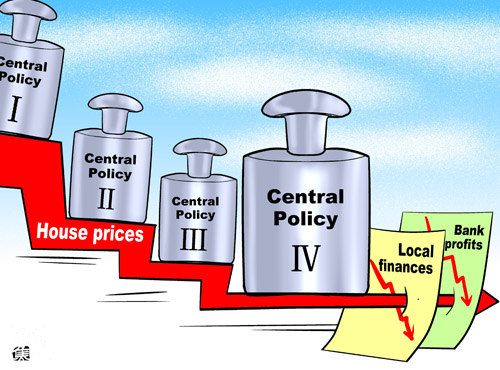
Heavy-handed policies [By Jiao Haiyang/China.org.cn] |
Both the market economy and capitalism take different forms in different countries and different historical periods. For such figures as Adam Smith and Joseph Alois Schumpeter, they advocated entrepreneurial capitalism, which is characterized by private property, free competition, survival of the fittest and creative destruction. Another form is state capitalism, which is prevalent in Latin America, Southeast Asia and Russia, among other countries.
As some scholars have pointed out, China's market economy is rooted in state capitalism, or, more accurately, bureaucrat-capitalism, as the word "state" is just an abstract concept which operates under a huge bureaucracy that has enormous power. Rather than focusing on social value, bureaucratic capitalism engages in profit-motivated economic activities through excessive political and administrative authority wielded by the government. It grants franchises and scarce resources to state-owned enterprises through administrative monopoly, special regulations and industrial policy.
Under bureaucrat-capitalism, preferential treatments were given to specific institutions and individuals. Collusion, manipulation and insider trading have not only trampled upon the legitimate rights and interests of other market participants and the free competition principle of the market economy, but also increased the risk and cost of private investment.
Under bureaucratic capitalism, monopoly and rent-seeking restrict market access and suppress competition, thereby jeopardizing the efficiency of the market economy. Instead of creating wealth, this just results in an unreasonable transfer of wealth.
Highly centralized political and administrative power, an opaque decision making process, and absence of appropriate checks and balances mean that bureaucratic capitalism often leads to rampant corruption and unfair play between state-owned enterprises and private enterprises.
In contrast, entrepreneurial capitalism advocates a fair and transparent regulatory and policy environment. It protects free competition so as to maximize the efficient allocation of resources. The main functions and responsibilities of government are to provide impartial social and public services with regard to judicial, taxation, defense and regulatory matters rather than becoming directly involved in or wantonly intervening in economic matters. Under entrepreneurial capitalism, the private sector in general works more efficiently and creates more employment. It generates higher profits, more tax revenue and a greater return on capital. State-owned enterprises get booted out the window.
In the medium to long term, the biggest advantage of entrepreneurial capitalism lies in its potential to encourage carve-out and innovation. Bureaucratic capitalism is also able to produce economic prosperity in a certain period of time. However, corruption, inefficiency and unfair competition will suppress people's enthusiasm in terms of carve-out and innovation, as well as hinder technological progress, industrial structural adjustment and economic restructuring, all of which will eventually result in economic stagnation. As we can see from the situation in Latin America, such stagnation will brew social and political crises. There are undoubtedly lessons to be learned from this.
China's per capita GDP has just exceeded US$5,000, so there is still enormous room for economic catch-up. But the uneven distribution of opportunities and incomes has caused a range of social problems which call for an increased emphasis on structural reform. In order to ensure sustainable economic and social development, the Chinese government must reign in its involvement in economic matters and allow the market to play the leading role.
This article was first published in Chinese and translated by Li Huiru.
Opinion articles reflect the views of their authors, not necessarily those of China.org.cn.


