Economic realities in US-China relations
- By John Ross
 0 Comment(s)
 Print
Print E-mail China.org.cn, February 16, 2012


Economic relations between China and the United States formed a central part of discussions during Chinese Vice President Xi Jinping's visit to the US. Analysis of economic fundamentals shows that in principle it is possible to resolve this aspect of the international situation with mutual benefit. But unfortunately non-economic issues, created by the US administration's approach, get in the way of rapidly resolving them.
|
|
|
A symbol of their love [By Jiao Haiyang/China.org.cn] |
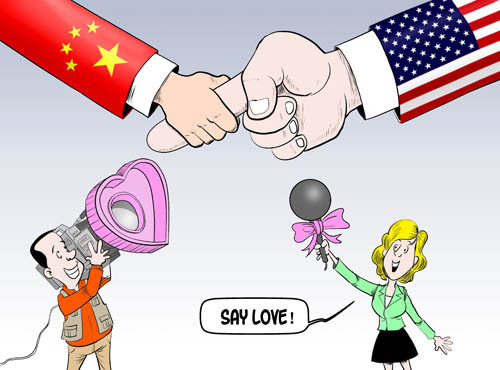
China's government approaches economic relations, as it states, and as economic trends outlined below practically demonstrate, from the point of view of securing "win-win" outcomes. In this framework , China's economic development benefits not only itself but also other countries, as it creates an increasingly large market for their products. Other countries' growth equally creates a greater market for China. Such economic relations, therefore, are part of an approach in which, while there will inevitably be frictions on individual issues, the overall outcome is positive for both sides. China-US economic relations should therefore be fundamentally cooperative and equal - "win-win".
Unfortunately the US administration has another framework - that of maintaining US "leadership". Such relationships are not based on equality but between a US "leader" and "followers" - "we lead-you follow." President Obama reiterated in his 2012 State of the Union speech: "renewal of American leadership can be felt across the globe."
Morally no self-respecting country can accept a "leader-follower" framework and practically the US can no longer impose it. Fortunately, despite this wrong US administration framework, it is unlikely the international situation will become uncontrolled - as US administrations no longer have the strength to impose such an approach.
These realities meant, despite "China bashing" from much of the US populist media, that Vice President Xi's visit was treated with the highest US protocol - 19 gun salutes, a longer than pre-advertised meeting with President Obama, prolonged meetings with Vice President Biden and Secretary of State Clinton.
Economically the fundamentals underlying this are that in approximately five years China's economy will be larger than the US. The annual expansion of China's market in dollars is already greater than the US. In the last four years, since the financial crisis began, the US economy grew by $1.1 trillion, whereas China's grew by $3.8 trillion. Even last year, with US recovery underway, China's GDP increased by $1.3 trillion compared to the US's $0.6 trillion. This translates directly into growth in trade and investment - the issues dominating economic media discussion during Vice President Xi's visit.
China will still take a few years to exceed the US in total imports, but the annual dollar increase in China's imports is already larger than the US - in 2011 US goods imports increased by $324 billion while China's increased by $350 billion.
Significantly, trade growth between both the US and the EU and China is also now larger than that between the US and EU. Comparing the latest available data, for November 2011, with the last quarter of 2007, before the financial crisis, US exports to the EU increased by an annualized $12 billion and EU export to the US increased by an annualized $7 billion. But US exports to China increased by an annualized $49 billion, while EU exports to China increased by an annualized $83 billion. US exports to China therefore grew four times as much as exports to the EU, and EU exports to China grew by almost 12 times as much as exports to the US. China is therefore a more important export target for the US than the EU - hence stress on economic issues during Xi Jinping's visit.
But these figures show the EU is gaining more from exports to China than the US - EU exports to China increased by an annualized $34 billion more than US exports to China. Given one of President Obama's top economic goals is doubling US exports in five years, how to increase exports to China comes right at the head of that agenda - reflected in the documents released during Xi's visit.
A parallel pattern in investment exists. Europe is now the largest destination for Chinese companies' foreign investment. It also accounted for 34 percent of China's outward investment in mergers and acquisitions in 2011. In contrast to this rising trend in Europe, China's investment in the US fell from $4.2 billion in 2010 to $3.2 billion last year.
Why is the EU gaining more than the US from trade and investment with China? It is not due to economic factors. The US has even more advanced industries than the EU, for which there would be a demand in China at least equaling that for the latter's products.
One reason for the US lag is its technological trade embargoes on exports to China. The logical pattern of exchange between China and the US is clear. At present the US cannot compete with China in lower and medium technology products, while China cannot compete with the US in the highest technology. In line with comparative advantage each should supply the other with that in which it is strongest. China does - supplying lower and medium technology products which have also had the beneficial effect for the US of keeping its inflation low. If the US refuses to export high technology products in return it can scarcely be surprised if it has a trade deficit.
China also has large foreign exchange reserves - a high supply of capital that can be invested abroad. This helps power its European investment. But the US has discriminated against Chinese companies -blocking China National Offshore Oil Corporation from buying US oil company Unocal and carrying out discriminatory actions against China's telecoms manufacturer Huawei - opposing it partnering with US firm Bain Capital Partners in a partial buyout of 3Com Corp and preventing it winning significant US contracts. The US wants the widest field for its companies' investments in China, while restricting China's investment in the US.
In terms familiar to US corporations, this constitutes "country risk". "China bashing" in the US necessarily leads China's companies to conclude the risk of doing business with the US is greater than the risk of doing business with the EU - therefore EU companies gain more from trade with China than US ones.
Perhaps Vice President Xi's visit will have helped convince the US administration that treating China and other countries as equals is not only morally correct but the only way to do the most successful business.
The author is a columnist with China.org.cn. For more information please visit: http://www.shenbo75.com/opinion/johnross.htm
Opinion articles reflect the views of their authors, not necessarily those of China.org.cn.


