The Xinhua billboard and Chinese soft power
- By He Shifei
 0 Comment(s)
 Print
Print E-mail
China.org.cn, August 3, 2011
E-mail
China.org.cn, August 3, 2011


 |
|
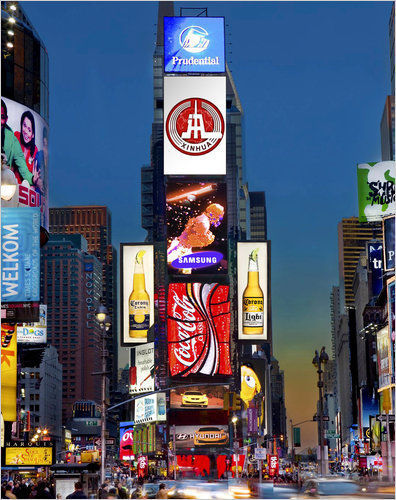
Signage?of Xinhua News Agency (second in the middle) at Times Square. |
Early Monday morning local time on August 1, Xinhua News Agency's signage lit up one of the highest-profile billboards at the north end of New York City's Times Square.
Taking over the advertising spot from HSBC Bank, the new Times Square billboard is the agency's most visible step in its American expansion. With an estimated half a million people passing through the area everyday, the debut will help promote awareness of Xinhua in the United States.
Relocating to the top floor of a skyscraper in Times Square this May, Xinhua is now situated right next to media giant Thomson Reuters in the hub of world news. According to Xinhua's North America bureau chief Zeng Hu, the Agency is also increasing its New York staff.
Xinhua is not the only Chinese media agency currently enhancing its U.S. presence. People's Daily Online, the online version of the national newspaper, recently opened its new office in New York's Empire State Building on July 11.
These recent moves are indication that Chinese state-owned news agencies are reaching beyond borders and plan to compete head-on with foreign media organizations for readership and financial success. These changes are transforming the landscape of Chinese media industry.
Entering on a more level playground in the international market, news agencies like Xinhua and People's Daily will no longer be shielded from open competition and rivalry. Instead of solely relying on the support of government, they will have to build their own reputation and credibility among new readers.
Bob Brunette, an American tourist visiting Times Square, told Reuters he had never heard of Xinhua and wouldn't care if it began to advertise there. Putting up a giant logo at "America's Crossroads" will not guarantee Xinhua's success, Brunette said.
The recent media expansion also serves the national interest of exporting China's soft power to an international audience. Since January, when a video promoting China's national image hit the wide LCD screens in Times Square, China has been attempting to draw international attention to its culture and traditions.
According to Joseph Nye of Harvard University, soft power is embedded in the values, culture, policies and institutions of a nation. Politically, a country which exudes soft power will be able to achieve its goals more easily, just as a charismatic employee can often harvest more support from willing colleagues.
During a visit to China back in 2008, Nye cited Japan as an example for the country to look at. Japanese pop culture had been popular around the world and acted as an attractive feature of the country, Nye said.
As the second largest economy in the world, China has notable hard power, but its traditional values and unique culture have yet to translate into international political influence. In 2007, President Hu Jintao's address to the 17th National Party Congress emphasized that the country needed to increase its soft power. Without doubt, the country has abundant resources to tap into to achieve this end. It also has perennial cultural trademarks that have a huge international fan base, including Peking opera, Chinese calligraphy and Chinese cuisine.
Nonetheless, the government and Chinese media groups need to pay special attention to the way they spread the country's message. As one Times Square tourist noted after seeing China's promotional video, "If you tone down a little bit, everyone will get the point." In this sense, down-to-earth, entertaining advertisements can be more warmly received compared to abrupt self-promotion. If they can learn to adjust their style, agencies like Xinhua will eventually prove more endearing to American audiences.
With its banner occupying space in Times Square next to brand names like Coca-cola, Prudential, and Samsung on the tower full of flashing displays, it is time for Xinhua to test its ability to accrue soft power.
He Shifei is a Chinese freelance journalist currently living in the U.S. Her research interests include government, politics and policy studies.
Opinion articles reflect the views of their authors, not necessarily those of China.org.cn


