UN reform: Between Scylla and Charybdis
- By Luo Huaiyu
 0 Comment(s)
 Print
Print E-mail
China.org.cn, June 20, 2011
E-mail
China.org.cn, June 20, 2011


 |
|
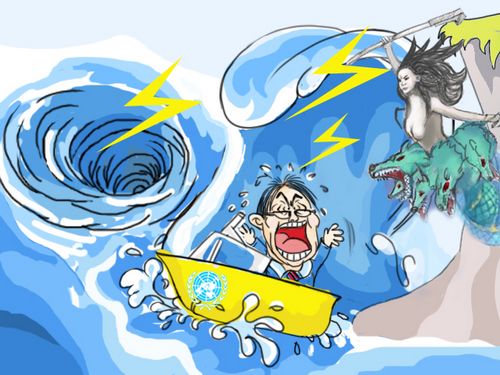
[By Qiguan Hong/China.org.cn] |
In Greek mythology, Scylla and Charybdis were two sea monsters besetting the narrow waters of the strait. Scylla was a six-headed monster with 12 long tentacles who dwelled in a cave of a cliff, snatching sailors and smashing ships, while Charybdis was a huge whirlpool off the coast sucking in anything that came by. Ships and sailors had to strike a proper balance because shunning Scylla would mean passing too close to Charybdis, and vice versa.
The United Nations is now caught between Scylla and Charybdis, and it has to achieve a new balance while strengthening itself so that it may continue to forge ahead in a secure direction. For the grand ship of the UN, its Scylla is the wide range of global challenges that bear heavily on the common destiny of man, such as war and peace, racial and religious conflicts, poverty and disease, territorial disputes, nuclear proliferation, climate change, and terrorism. Its Charybdis is the sovereign states that have the power to control or dominate.
The relationship between the ship and the two monsters is something of a paradox. On the one hand, no country in the world can prevail over "Scylla" — the mounting global challenges — separately without the coordination of an authoritative world body. But, if the UN is to acquire enough legitimacy to combat "Scylla," it has to appease "Charybdis" and get overwhelming support from sovereign states.
Over the past 60 years or so, the equilibrium between the UN, sovereign states and the aggregation of global challenges is becoming increasingly difficult to maintain. The world has changed tremendously, both in power structure and the magnitude of global challenges, but the world body is still operating under the same power structure established in 1945. That partly explains why the UN is losing its edge in contemporary world affairs that call for multilateral collaboration. Under such circumstances, it is highly necessary for this waning international regime to undergo a systematic overhaul to enhance authority, increase representativeness and improve efficiency.
Few doubt the necessity for reform, but nations are still sharply divided on the nature, purpose and design of the reform. The past two secretary generals, Ban Ki-moon and Kofi Annan, have both urged for immediate reform of the Security Council, where decisive power still rests in the hands of the same five countries that each have the right to veto any resolution. Further complicating the issue is the emergence of a number of cliques, most ostensibly the Group of Four (Japan, Germany, India and Brazil), the United for Consensus movement (initiated by Italy, Pakistan, Argentina and Canada) and the Committee of 10 African States. Their open positions clearly reflect the degree of competition and divisiveness, not to mention undercover lobbying and dealings.
Our world today cannot afford to lose yet another golden opportunity to change. If the UN is going to lead the world in fighting the "Scylla," it must first try to make "Charybdis" happy. Now the time is ripe for the UN to infuse some new blood into its decision-making. But in doing so, it should more than ever rely on the collective deliberation of the five permanent members rather than do anything threatening their vested interests. Only then will the ball get rolling for a positive turn. If the UN does not rely on the Big Five but subjects the reform to extensive public voting, then reform may be drawn into the vortex of "Charybdis" and fail to deliver anything substantial.
The following three points, therefore, should to be observed in enlarging the membership of the Security Council. First, the original five permanent chairs and their privileges should remain intact. Second, the Security Council should be supplemented with a number of permanent members with or without veto rights or non-permanent members on a term basis. Third, the realization of the supplementation should be subject to the collective deliberation of the five permanent members.
In deciding which countries to be added, consideration should primarily be given to geopolitical factors so that all continents and regions can be properly represented on the Security Council. Selection should be based on moral standing and credit history, including international responsibility, human rights status, and a historical resume testifying to its long-term stable capability to uphold justice, rather than size, population or economic clout.
The fight against "Scylla" requires a strong and effective "captain" to coordinate the action of "sailors and crew" to hold "Scylla" at bay while steering the ship away from the vortex of "Charybdis." Let us all take a long-term view and respond to a higher call for humanity by giving the UN more support.
The author is a China.org.cn columnist. For more information please visit:
http://www.shenbo75.com/opinion/luohuaiyu.htm
Opinion articles reflect the views of their authors, not necessarily those of China.org.cn


