Inclusive growth for harmony
 0
0 


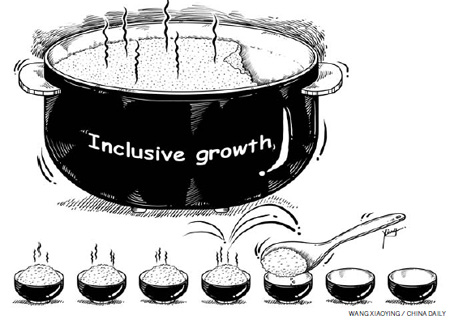
President Hu Jintao's remarks on "inclusive growth" made at the recent Asia Pacific Ecnomic Cooperation ministerial meeting underscore how China will reorient its growth model to make economic benefits more widely shared. The remarks are all the more significant, coming as they did in the midst of government deliberations on the country's 12th Five-Year Plan (2011-2015), which sets the near-term course for development.
Rising income inequality has cast a long shadow over China's otherwise spectacular economic rise of the last 30 years. Even as per capita gross domestic product grew by about 9 percent a year during 1979-2008, lifting a large section of the population out of poverty, its income inequality has risen to among the highest in Asia.
The government has in recent years taken action to address this issue through such measures as infrastructure investment in the lagging western and interior provinces, policies to facilitate rural development and benefit the farmers and rural migrant workers, and more spending on basic education and healthcare to protect vulnerable groups. More recently, it unveiled its vision of a harmonious society.
Many argue that the next five years represent a critical period for China to make significantly greater progress in reducing income inequality and toward this vision. Inclusive growth, as a practical strategy, has a pivotal role to play.
In the most general sense, one could consider growth to be inclusive when every member of society participates in and benefits from it on an equitable basis.
Critically, policies for inclusive growth should distinguish between two types of inequality. One is driven by unequal access to opportunity and circumstances beyond the control of individual - reflecting largely market and policy failures, institutional weaknesses, or social exclusion. The other is driven by differences in effort and reflects the rewards and incentives that a market economy provides for citizens who work harder, look for opportunities, and take risks in seizing them.
Naturally, it is the unequal access to opportunity that must form a nonnegotiable target of policy interventions toward inclusive growth. Accordingly, inclusive growth can be defined as "economic growth coupled with equality of opportunity".
How to translate this into policy actions?


