Learning from Obama's Town Hall Meeting
 0 Comments


US President Barack Obama held an unprecedented town hall meeting in Shanghai on November 16, 2009, to "talk directly with China's youth". He talked about the history of US-China relations, preached the "universal rights" of man, and took questions from the audience and the online community. The President's speech was hailed by the Chinese media and intelligentsia as an important sign of the warming relationship between the two countries.
The significance of his visit was partly because it came amid such extraordinary world events. Obama was also the first US President to visit China in his first year in office. But what caught my attention was the symbolism of the format of the occasion—a town hall meeting.
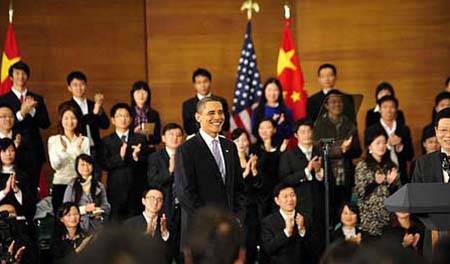 |
| US President Barack Obama held a town hall meeting with college students in Shanghai, November 16, 2009. |
Town hall meetings are part of the American political tradition - informal public meetings in which citizens are invited to voice their opinions and listen to responses from public figures and elected officials. They are mass public gatherings that allow citizens to speak to those in power on an equal footing.
Despite their importance in American political life, town hall meetings are not an American invention. As far back as the sixth century BCE, the city-state of Athens developed similar public gatherings - the earliest example of democratic decision-making.
Such meetings never took place in ancient Chinese society, dominated as it was by imperial power and patriarchal authority. In today's China, people have more civil and political rights than ever before, thanks to the reform and opening-up of the past three decades. China's Constitution states: "The people administer state affairs and manage economic, cultural and social affairs through various channels and in various ways in accordance with the law." But putting this into practice in a meaningful way remains a challenge for the whole nation. We should not try to accomplish it so fast as to pursue speed at the expense of substance. But we need to encourage mass participation and push forward grassroots democracy in earnest.
China doesn't yet have town hall meetings but we have similar mechanisms, such as government hearings and the system of government spokespersons. Yet while acknowledging there has been some progress, we have to admit that many hearings would make more sense if there was more participation and communication, and less monologue and affectation. We should learn from US town hall meetings in this regard.
Obama's town hall meeting in Shanghai was translated as "mian dui mian," which, in Chinese, means "face to face" - which reflects certain conceptual differences. In Chinese terms, emphasizing "face" may not contribute to solving problems. When we gather in the public interest, we should forget our "face". Wouldn't it be better to say, "idea to idea", "opinion to opinion", or "heart to heart"?
?Mr.Luo Huaiyu is a lecturer with the School of Humanities and Law, Beijing University of Chemical Technology.


