The wreckage of US and Russian satellites that collided over Siberia poses a threat to China's satellites in orbit, but the country's space plan will proceed as scheduled.
 |
|
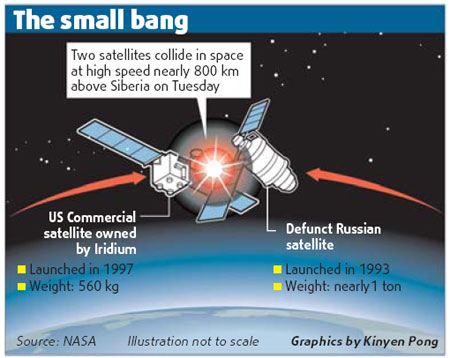
A privately owned US communications spacecraft collided with a defunct Russian military satellite about 800 km above northern Siberia at 4:55 pm GMT on Tuesday. [China Daily] |
A privately owned US communications spacecraft collided with a defunct Russian military satellite about 800 km above northern Siberia at 4:55 pm GMT on Tuesday, according to the US Strategic Command, which made it public on Wednesday.
The 560-kg US satellite, of Iridium Holdings LLC, was launched in 1997 and the Russian Cosmos-2251, weighing almost a ton, was sent in space in 1993.
Chinese scientists are monitoring the debris to gauge the potential threat to the country's satellites, said Tang Bochang, co-designer of China's first spaceship Shenzhou I. But the country's space exploration program, including sending a "space laboratory module" next year, will not be delayed.
It is not known yet whether the crash was an accident or took place because of a human error, said Tang, who is also chief designer of recoverable satellites with Beijing-based China Academy of Space Technology. But the 500 or so pieces of the two satellites floating in space pose a potential threat to the more than 900 satellites. Most of them have been sent by US, Russia and China (which has 54 satellites).
The Chinese space authority has prepared back-up plans. "We can adjust the orbits of the satellites already in space. And we can redesign the orbits of those yet to be launched," Tang said.
About 4,000 satellites and used rocket parts, apart from about 6,000 pieces of debris that can be seen, are traveling in space around 20,000 km an hour, according to NASA.
The two satellites' wreckage poses little threat to the International Space Station, about 1,200 km above the Earth's surface, NASA and the Russian Federal Space Agency both said yesterday.
But it would take weeks to determine the full magnitude of the crash, NASA said. "We knew this was going to happen eventually," said Mark Matney, an orbital debris scientist at Johnson Space Center in Houston.
A spokesman for the Russian civilian space agency Roscosmos, Alexander Vorobyev, said on state TV's Channel I that "for the international space station, at this time and in the near future, there's no threat".
Tuesday's collision was the first high-speed impact between two intact spacecraft, NASA officials said. Space objects in orbit have collided accidentally on four other occasions, NASA said. But those were considered minor and involved parts of spent rockets or small satellites.
Iridium Holdings has a system of 65 active satellites, which relay calls from portable phones that are about twice the size of a regular mobile phone. It has more than 300,000 subscribers, with the US Department of Defense being one of the biggest.
The company said the satellites' loss was causing brief, occasional outages in its service and that it hoped to fix the problem by Friday. Iridium expects to replace the lost satellite with one of its eight in-orbit spares within 30 days.
(China Daily February 13, 2009)