Marine scientists from California are venturing this week to the middle of the North Pacific for a study of plastic debris accumulating across hundreds of kilometers of open sea dubbed the 'Great Pacific Garbage Patch'.
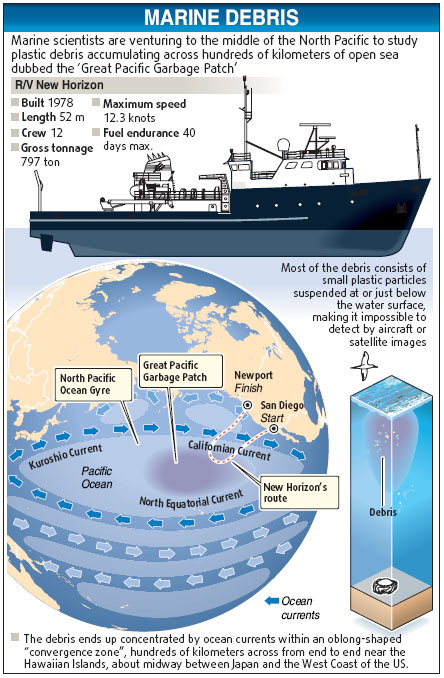
A research vessel carrying a team of about 30 researchers, technicians and crew members embarked on Sunday on a three-week voyage from the Scripps Institution of Oceanography, based at the University of California at San Diego.
The expedition will study how much debris - mostly tiny plastic fragments - is collecting in an expanse of sea known as the North Pacific Ocean Gyre, how that material is distributed and how it affects marine life.
The debris ends up concentrated by circular, clockwise ocean currents within an oblong-shaped "convergence zone" hundreds of kilometers across from end to end near the Hawaiian Islands, about midway between Japan and the West Coast of the United States.
The focus of the study will be on plankton, other microorganisms, small fish and birds.
"The concern is what kind of impact those plastic bits are having on the small critters on the low end of the ocean food chain," Bob Knox, deputy director of research at Scripps, said on Monday after the ship had spent its first full day at sea.
The 52-meter vessel, New Horizon, is equipped with a laboratory for on-board research, but scientists will also bring back samples for further study.
Little is known about the exact size and scope of the vast debris field discovered some years ago by fishermen and others in the North Pacific that is widely referred to as the 'Great Pacific Garbage Patch'.
Large items readily visible from the deck of a boat are few and far between. Most of the debris consists of small plastic particles suspended at or just below the water surface, making it impossible to detect by aircraft or satellite images.
The debris zone shifts by as much as 1,600 km north and south on a seasonal basis, and drifts even farther south during periods of warmer-than-normal ocean temperatures known as El Nino, according to information from the National Oceanic and Atmospheric Administration.
Besides the potential harm to sea life caused by ingesting bits of plastic, the expedition team will look at whether the particles could carry other pollutants, such as pesticides, far out to sea, and whether tiny organisms attached to the debris could be transported to distant regions and thus become invasive species.
(China Daily via Agencies August 5, 2009)





