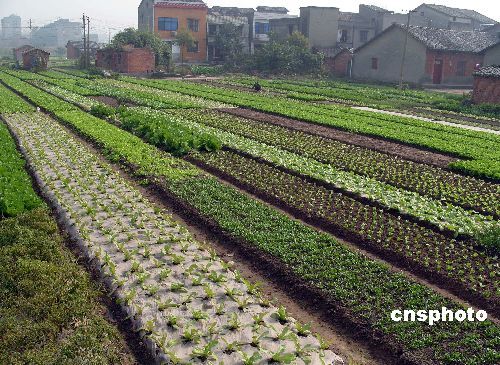
As industrialization and urbanization continue to encroach on China's arable land, the country is grappling with ways to keep enough farmland to feed its people.
The country is already edging close to its "red line" of 1.8 billion mu (120 million hectares) of arable land needed to feed its population, with 1.826 billion mu available at the end of last year, Lu Xinshe, deputy head of the Ministry of Land and Resources, said yesterday
![Farmers plant seedlings in Tancheng, Shandong province, on Monday. [Photo from China Daily]](http://images.china.cn/attachement/jpg/site1007/20090624/001109b42f730babc3de02.jpg "Farmers plant seedlings in Tancheng, Shandong province, on Monday. [Photo from China Daily]") |
|
Farmers plant seedlings in Tancheng, Shandong province, on Monday. [Photo from China Daily] |
"As China is still in the period of fast industrialization and urbanization, taking over some arable land is inevitable," Lu said.
With the launch of the 4 trillion-yuan economic stimulus package to boost domestic demand, "the Ministry of Land and Resources is facing new challenges in protecting the shrinking farmland", Lu said.
Every plot of arable land taken up for housing or industrial projects is supposed to be replaced by an equivalent parcel of land freed up by consolidation of smaller plots or the takeover of former industrial properties.
"Every year, around 4 million mu of land is added," Lu said.
To combat the problem, marginal farmland would no longer be allowed to return to woodland, Lu said.
"To protect our 'red line' of 1.8 billion mu of arable land ... we will not plan any new large-scale projects to return farmland to its natural state, beyond those that have already been planned," he told a news conference.
As more investment is being used on the construction of factories and offices, the ministry also needs to ensure that these developments are legal, Lu said. Among the biggest threats to sustainable land use are projects abandoned midway because of lack of money and land abuse, including pollution.
The ministry also needs to ensure compensation is paid to farmers who are forced from their land to make way for development, Lu said.
China may have difficulty following the 120 million-hectare requirement by 2020, Liu Xiahui, a researcher from economy research institute of the Chinese Academy of Social Sciences told China Daily yesterday.
Economic development and land protection issues are controversial for most governors, and incentives need to be put into place, Liu said.
 |
|
More than 60,000 cases involving illegal land use were reported last year, statistics from the Ministry of Land and Resources showed. |
"The central government should give high rewards to provinces or cities who protect land well to make up for the economic losses, or there is no motivation to protect the land," Liu said.
The ministry has established a hotline with the number 12336 for people to report land abuse. The lines open tomorrow.
More than 60,000 cases involving illegal land use were reported last year, statistics from the ministry showed.
Construction projects using about 3.5 million mu (233,000 hectares) of land were approved between January and May this year. This represents about 56 percent of the total land quota for this year, according to the statistics from the ministry.
(China Daily June 24, 2009)





