Pests and diseases plague crops
 0
0 


China's farmlands face a serious increase in pests this year, in addition to the current prevailing long-lasting drought, the Ministry of Agriculture said.
This year, the accumulated arable areas hit by plant diseases and insects are expected to reach 402 million hectares due to global warming and catastrophic drought, according to a notice posted on the ministry's website on Friday.
 |
|
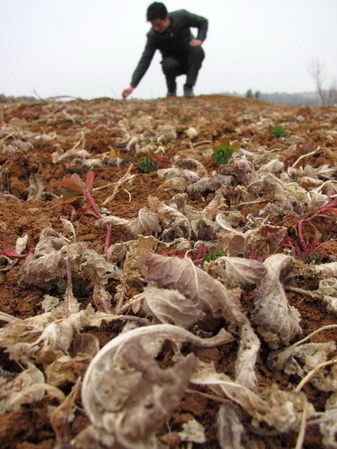
A farmer from Yanghe village in Shiyan, Central China's Hubei province, checks on withered bok choi plants on his farm on Friday. Winter wheat and vegetables in the province have been severely affected by several months of drought. [Xinhua] |
Some plant diseases and insects, including red wheat mites and aphids, which are a great threat to wheat, have attacked most of the country's wheat-producing areas and the situation has worsened recently, according to the notice.
"Plant diseases and insects are more serious this year, compared to the annual affected areas of 268 million hectares in previous years," Li Maosong, director of the agricultural information office at the Chinese Academy of Agricultural Sciences, told China Daily on Sunday.
By Feb 15, 1.1 million hectares of wheat-planting areas in seven provinces along the Yangtze-Huaihe River Plain and in northern China had been damaged by red wheat mites, a 140 percent year-on-year increase, official figures showed.
Also, as many as 864,300 hectares of wheat-planting areas had been hit by aphids by Feb 15, a 2.4 times increase over last year, with the pests particularly severe in provinces, such as Henan, Shanxi, Shandong and Anhui, the ministry said.
Li said that usually around 15 percent of the grain harvest is lost to plant diseases and insects every year.
"Because plant diseases and insects can be prevented and controlled when effective measures are taken in time, this year's loss will not increase."
But he said that precise and timely monitoring of plant diseases and insects was necessary "to avoid pesticide misuse".
So far, the ministry has sent 14 relief teams to the major areas hit by plant diseases and insects. In the main grain-producing areas, professional teams organized by local governments are in charge of the management and use of pesticides to reduce grain loss.
Due to the low rainfall and higher temperatures expected in most regions in the coming spring, the areas affected by pests will grow rapidly in the near future, the National Climate Center predicted.
For instance, rice planthoppers and rice leaf rollers, which pose a grave threat to the country's rice production, are likely to ravage most rice-producing areas in southern China, the center said.
The pest infestations come on top of the continuing dry spell in northern China's wheat heartland, which has caused considerable international concern and sparked a warning from the United Nations earlier this month about the possible loss of the winter crops, a key harvest for the world's biggest grain producer.
By Feb 17, drought had affected 6.6 million hectares of winter wheat farmland in eight provinces including Hebei, Henan, Shanxi and Anhui, according to statistics from the Ministry of Agriculture.


