China to conduct census of rare golden monkeys
 0
0 


Shennongjia Nature Reserve in central China's Hubei Province will launch a five-month-long population census of the endangered golden monkey next month to find out if the numbers of this rare Chinese species have increased, a researcher said Wednesday.
 |
|
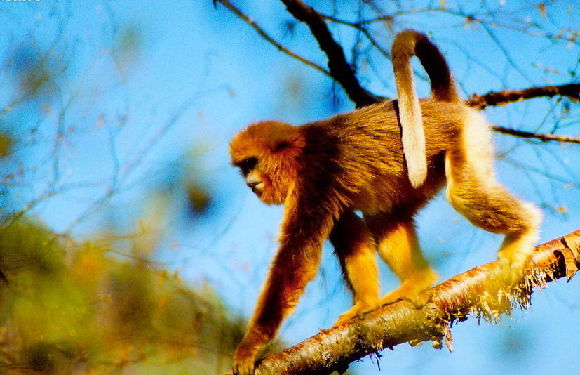
Golden monkey [File photo] |
Although the last census, conducted in 2005, showed the number had doubled to more than 1,200 since the 1980s, scientists are unsure what the population trend of the rare animal has been during the past five years.
"We cannot say the number has increased until the census is done, as food shortages and snow storms in winter remain fatal to some golden monkeys," Yang Jingyuan, head of the reserve's research institution, told Xinhua in an exclusive interview.
"In 2008 alone, we found 13 dead monkeys after snowstorms," he said.However, he said the number of golden monkeys could have increased as researchers have been supplying food to these animals during the winters since 2005.
Researchers have been placing apples and oranges onto the sharp ends of chopped tree branches along the monkeys' migratory routes, to make them believe that the fruits had grown on trees and, therefore, could be eaten, Yang said.
More than 30 people, including researchers and forest rangers, are expected to participate in the census. They would work in five teams to monitor different groups of golden monkeys, he said.
"Winter will be the best time for the census as all the tree leaves will have fallen by then, and will provide us a better view of the monkeys," he added.
The Shennongjia golden monkeys, which live in deep forests at altitudes of between 1,680 to 3,000 meters, are on the verge of extinction.
They were first spotted in Shennongjia in the 1960s. The first census in the 1980s revealed that only 501 golden monkeys lived in the area.
Its population had expanded to 1,280 by 2005 after local environment was better conserved.
Located in the northwestern mountains in Hubei Province, the Shennongjia Forestry District, which administers the nature reserve, boasts rich natural forest resources. It used to contribute over 100,000 cubic meters of timber every year to support China's economy between the 1960s and the 1980s.
But in the 1990s, the local government decided to stop looking at Shennongjia as a source of timber and turned it into a forest conservation area after deforestation seriously damaged the local ecology and reduced the number of wild animals.
Today, forest coverage in the district exceeds 88 percent, up from around 63 percent in the 1990s.
Dubbed "Noah's Arc" for animals and plants from the glacial period, the Shennongjia area provided shelter for animals and plants from glacier activities that were prevalent elsewhere during the Quaternary period some 2.5 million years ago. It has preserved an array of plants that existed in the Tertiary period and is widely called a home of living plant fossils.
It is also believed to be home to the legendary Bigfoot-like ape man.
The Shennongjia golden monkey is a sub-species of the Chuan golden monkey -- one of three kinds of golden monkeys which can be found only in China.
Regarded as China's "state treasure," just like the giant pandas, golden monkeys are under the state's top level protection. They also live in southwest China's Sichuan Province and in the northwestern provinces of Shaanxi and Gansu. There are less than 25,000 golden monkeys in the world.


