What climate change looks like on the front lines
 0 Comments


 |
|
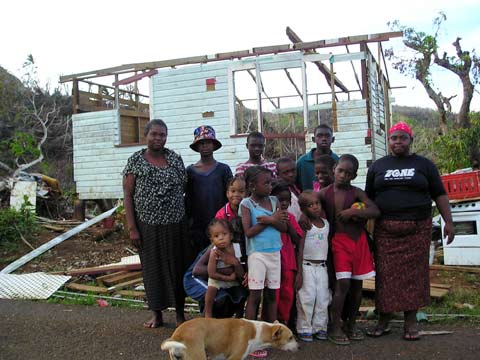
Hurricane'Ivan' smashed 'Ivan' smashed many houses to matchsticks in Grenada in 2004. [File picture] |
But more than the slight change in precipitation is the repeated onslaught of powerful hurricanes that concerns David.
"Hurricanes traditionally went much further north," he said. " Only five years ago, we had Hurricane Ivan."
In 2004, Grenada was devastated by the Category Three hurricane. The financial cost of the disaster was estimated at more than 900 million U.S. dollars, roughly 204 percent of Grenada's gross domestic product (GDP).
"I think the whole world must have been aware of the devastating effect it had on our economy," said David. "But I think more importantly (was) the impact of the hurricane on the people at the time. I think we've become much more sensitive to the issue of climate change since that."
Tiny Steps
While the world hums and haws on a climate deal, the government of Grenada has been trying to adapt to environmental challenges.
On the coastal town of Soubise, residents have been told they must move inland as part of a government relocation project funded by the Chinese government, according to Kem Jones, a community projects officer for the National Disaster Management Agency, and Betty Ann Lazarus, communications director for the Department of Foreign Affairs.
Wedged in between the ocean and the road, homes there sit practically on the shoreline. They are protected only by a thin wall of mounted rocks and pieces of scrap metal.
Oliver Noel, a fisherman who lives in Soubise with his wife and eight children, said after some delay, he has heard of more talk about moving.
But Lazarus said residents don't want to leave their homes because of the convenient location near the ocean, to fish, and the road, to catch the bus.
Meanwhile, further inland, Aden Fouteau, acting chief forestry officer form the Forestry and National Parks Department, is busy overseeing a major reforestation projection. With winds from 111 to 130 miles per hour, Hurricane Ivan destroyed about 90 percent of the forest, causing a a series of problems in soil erosion, biodiversity, and ecotourism.
Limited resources and a small staff has made progress slow, said Aden as he walked through the Grand Etang Forest Nursery.
"What we are doing here is just a drop in the bucket compared to what is needed in Grenada," he said.
Back in St.George's, David said what his country needs is a bottom line arrangement on carbon emissions that ensures Grenada's survival.
"I have children and as young as I look I have grandchildren and I do wish to leave in a better place than I came in, not a place worse off when I came to this land," he said. "We look around and we see the seasonal changes, we look around and we see the impact it's having on our environment, we look around and see what its having on our fishing industry."
"Certainly as an individual I believe that we as small states must play our parts. So for me personally, it's a major issue. For us as policymakers, it's a major issue, and for us as a people it' s a major issue."


