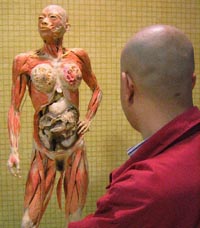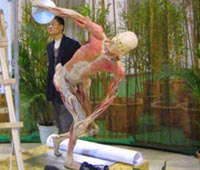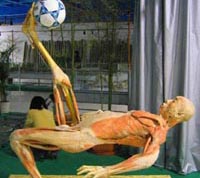
Standing amid a row of dissected corpses, it is easy to imagine you are in a scene from a Hollywood Dracula movie or a nightmare, rather than an art exhibition.
The exhibition opens in Beijing on Thursday with specimens supplied by the Dalian Medical Institute.
Staged at the China Architectural Culture Center, this Chinese version of the preserved human corpse show launched by the German anatomist Gunther Von Hagens in 1997. It even carries the same name as Von Hagens' -- Body Worlds, which has drawn nearly 14 million visitors around the world.
Professor Chen Kequan, vice chairman of the Chinese Anatomical Association, claimed the exhibition was for education, rather than financial gain.
"Different from the similar exhibitions held in the foreign countries, the aim of our exhibition is not for commercial purposes, but to give the public an opportunity to understand the human body and its functions, and to focus attention on health," he said.
"The bodies were used for study at our institute, which was approved by local government and they all died naturally," said Sui Hongjin, deputy director of the institute's anatomy laboratory.
Sui is the former business manager at Von Hagens' production site in Dalian. He left the German company and set up the biological plastination co. Ltd, of the Dalian Medical Institute in 2000. All 17 whole bodies and over 160 healthy and diseased body parts on display were all the works of Sui and his fellow colleagues.
The plasticized bodies and body parts were processed to replace fluids and fat in bodies with special plastic materials, making the bodies durable for exhibition and study, said Sui.
The process serves not only to better conserve bodies but to make specimens more lifelike and colorful, compared with the specimens that used to be preserved in formal dehyde.
"Plastination does not destroy the bodies and we do respect the dead, who are making a contribution to scientific study," said Professor Chen Kequan, vice chairman of the Chinese Anatomical Association.
The show has received little attention among the public in China, but there has been widespread criticism of similar exhibitions overseas.
Organizers have relaxed restrictions to allow visitors to touch specimens if they are willing to and in order to attract more young people, students can buy half-price tickets, for 25 yuan (US$3) each.
"It is acceptable if they had the bodies processed for better conservation for scientific study, but I don't understand how could they plan to show a corpse as art in public. In Chinese tradition, people should respect the dead," said 56-year-old Wang Xiaolin, a retired teacher from southwest China's Sichuan Province on holiday in Beijing.
"But I'd like to go to the exhibition and I have read reports about such exhibitions before. I think it is interesting and cool and I believe it would be an eye-opening experience, although I might have nightmares afterwards," said Wang's daughter Yi Lan, 23,a college student.
In fact, the 3000-square-meter-large meter exhibition hall where the bodies are displayed is well lit and is even decorated with plants. The models are made in different poses -- a basketball player here, a runner there.
The special arrangements are waiting a public test as foreign media reported that an average of one visitor fainted per day at Body Worlds shows overseas.
"I'm afraid that I will not take my 6-year-old boy to the show, even though he is very interested in biology, because I don't know if it will upset him," said a woman, who gave her surname Jiang.
The organizers also do not know how long the exhibition could last.
"We plan for the show in Beijing to run four months, but it depends on the reaction of the visitors and I hope it can go around the country," said Sui.
(China Daily April 8, 2004)
|