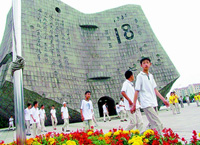
"Red tourism" is certainly a catchword in China nowadays.
By visiting "red scenic spots" historical places, sites that in one way or another have relevance to China's revolution visitors can not only relax during a trip but also relive the people's republic's resourceful "red history," a period spanning from 1921, when the Communist Party of China was born, to 1949 when new China was founded.
So, although a brand new travel concept, "red tourism," through the prefect combination of patriotic education and recreation, is now booming in places where major revolutionary sites are located.
The National Tourism Administration even designated 2005 the "year of red tourism."
But "red tourism," its promoters say, has another significance.
It is well known that most of the revolutionary sites are found in mountainous areas or remote regions usually economically backward places.
"Red tourism," therefore, seems a sensible way to help develop the local economies of such places, which, in the past, sacrificed a lot to the revolutionary cause.
However, "red tourism" operators should be cautious that it does not become a fleeting fashion, but develop in a sustainable way.
Simply visiting "red scenic spots" runs the risk of boring tourists. Although such places are rich in historical content, they lack variety.
Making things worse is that many "red scenic spots" are scattered and isolated, which means potential visitors at times have to travel long distances to see just one or two historical sites.
The operators, therefore, must look squarely at these drawbacks and devise strategies to tackle them, if this theme tourism is to survive and thrive.
They should be aware that "red tourism" should be managed in accordance with market law.
Southeast China's Fujian Province has offered us a successful model.
This coastal province, which is opposite Taiwan, has a significant place in China's "red history."
In the late 1920s and early 1930s, Fujian was a major "red base" for the Red Army, which left behind many "red scenic spots."
For example, the famous Gutian Meeting, a milestone in the Party's history, was held in the small town Gutian in 1929. Fujian tourism authorities, however, have not tried to develop "red tourism" by exclusively relying on exploring their abundant "red scenic spots."
Instead, the province tried, rather successfully, to add "red scenic spots" to more mature travel routes, combining them with other travel resources to make them more attractive.
For example, it added the Gutian Meeting venue to an existing travel route, which includes nearby scenery that is not necessarily "red" in any way.
The diversified and varied combination of "red scenic spots" and other tourism resources such as unique local culture and peculiar natural beauty, are making this kind of travel experience enlightening yet enjoyable for visitors.
Fujian's efforts are paying off.
Gutian received 648,000 visitors in 2004, an increase of 35 per cent year-on-year.
Such tangible results are a solid testament that "red tourism," if properly managed, has an elastic and enduring life.
Fujian's model, however, is just one of many possible ways to nurture "red tourism."
It is hoped that other places, when developing their "red tourism," can learn from Fujian and come up with other creative ways that are suitable to their local conditions.
(China Daily July 9, 2005)
|