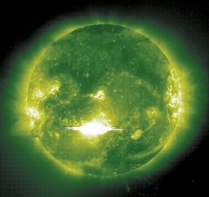
One of the largest known solar flares erupted from the sun on Tuesday, heralding a storm of superheated gas that could hit Earth within a day.
The outburst was classified an X17.2 flare, the third largest on record, according to Paal Brekke, a project scientist with the Solar and Heliospheric Observatory (SOHO), a sun-watching satellite mission jointly run by NASA and the European Space Agency.
In comparison, two solar storms observed last week were between X1 and X5, Brekke said.
Solar flares are associated with coronal mass ejections, or CMEs, eruptions from the sun that, if headed our way, can disrupt communications satellites and power grids.
As this particularly fast-moving CME is aimed directly toward Earth, it is possible that when it arrives midday Wednesday, the geomagnetic activity will be strong enough to stir up electrical trouble.
"The eruption was positioned perfectly. It's headed straight for us like a freight train," said John Kohl, a Harvard-Smithsonian Center for Astrophysics scientist, in a statement. "A major geomagnetic storm is bound to happen."
Brekke is not so sure and awaits more data from SOHO and another deep space solar-watching satellite positioned between the sun and Earth.
"Until we know the orientation of the magnetic field in this cloud, we will not know how severe the geomagnetic storm will be."
Interacting with Earth's magnetic field, the high-energy solar winds produced by a CME often increase night displays of the northern and southern lights.
"Not all CMEs trigger auroras. Several, for instance, have swept past Earth in recent days without causing widespread displays," said Tony Phillips of Spaceweather.com, which monitors cosmic conditions related to the sun and Earth.
It all depends on the orientation of tangled magnetic fields within the electrified cloud of gas. This CME is no exception. It might cause auroras, or it might not. We will find out when it arrives."
Researchers classify solar flares using three categories: C for weak, M for Moderate and X for strong. The largest flare on record, one of two known X20s, occurred on April 2, 2001, but was not directed at Earth.
In March 1989, an X15 burst knocked out power for millions of people in Canada. In recent years, however, satellite and utility operators have devised safeguards that usually minimize damage from solar storms.
Space weather forecasters say this spate of strong solar flares unusual because it is not following normal patterns of solar behavior. The sun follows an 11-year cycle of activity and the last peak took place in 2000.
(People's Daily October 30, 2003)