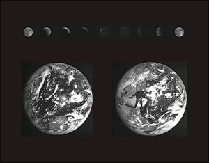
A spectacular portrait of earth and its satellite, the moon, together has been captured for the first time during an eclipse by a space camera, the European Space Agency said.
Bernard Foing, lead scientist of the ESA's unmanned exploratory probe SMART-1, said the picture was snapped October 28 during a lunar eclipse when the spacecraft was 300,000 kilometers (186,000 miles) away from the earth.
"Never ever has this been done," Foing told AFP on the sidelines of the International Conference on Exploration and Utilization of the moon in the northern Indian city of Udaipur.
A week ago SMART-1, which also successfully tested a revolutionary form of propulsion, was captured by the moon's gravity and is looping the moon at a distance of 5,000-50,000 kilometers (3,000-30,000 miles).
It will get closer to the lunar surface in a egg-shaped polar orbit that will vary from 300 kilometers at the South Pole to 3,000 kilometers at the North Pole.
Foing, who is now ESA Chief Scientist, said SMART-1 also detected traces of argon gas for the first time being reflected off the earth's surface.
Argon gas constitutes just one percent of the earth's atmosphere and is used in electric bulbs and for welding aluminum and stainless steel.
"It's a good glow. We're now opening a new window of opportunity (for scientists)," Foing said. "More analyses will be done in the future with X-ray data."
Argon, an inert gas, can be used to indicate the temperature of a space body during its formation and its evolutionary history.
During the last four months since its launch September 27, 2003, the optical camera observed the earth and moon.
The X-ray experiment will carry out X-ray global mapping for minerals in the moon such as silicon, magnesium and aluminum.
"By June I think the new results of the survey will come out," Foing said.
He said the SMART-1 was powered by a new technology, an ion engine, which converts solar power into electricity that charges atoms of the heavy gas xenon. These charged atoms, known as ions, are then disgorged from the back of the probe to give it thrust.
"The mission accomplished what it set out for. It will be useful in future missions as it is the most complicated orbit we (ESA) have ever done," Foing said. "It has withstood solar radiation glare and storms."
"In the future this engine can be used for exploration of Mercury, Mars and even the Sun," he said. "All this at a very low cost. The fuel in the spacecraft is only 20 percent of its weight. Other crafts can cost three times more."
The total cost of the project was 100 million euros (US$130 million), Foing said.
Scientists say the technology could form the basis of a new generation of cheaper space probes. Smart-1 could be the first of a new fleet of spacecraft, enabling exploration to become more commonplace and heralding a new era of discovery.
(CRI November 24, 2004)