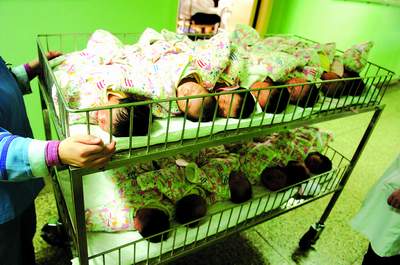
Sex ratio for newborns aged zero to four had reached 163.5 boys to 100 girls by the end of 2005 in Lianyungang, a city in east China's Jiangsu Province.
Similarly alarming figures have also been recorded in Hainan, Henan, Guangdong and Anhui, with Hainan chalking up a ratio of 136 to 100, according to a report of the China Family Planning Association (CFPA), which called for attention to the severe challenges in population affairs.
A total of 99 cities had sex ratios higher than 125 and the national average figure reached 119 in 2005, the CFPA said.
The normal sex ratio should be kept below 107:100, according to the United Nations standards.
The CFPA, which is affiliated to the National Population and Family Planning Commission (NPFPC), attributed the gender imbalance to sex-selection abortions aided by ultrasonic scanning, which is banned by regulations but still pervasive in many places.
"The root reason should be the traditional thinking that boys are better than girls, especially in poverty-stricken areas. Those people expect boys to support the family by going out for jobs," said Song Jiang, a professor of Population and Development Department of the Beijing-based Renmin University.
Highly imbalanced sex ratio may seriously affect stability and harmony, Jiang said, noting it increases difficulties for men in poor areas to find spouses.
The report, delivered at a recent forum in Shenyang, northeast China's Liaoning Province, also mentioned other population-related challenges confronting China.
It said that as net population growth maintains an annual rate of eight to ten million, China will meet its population peak of about 1.5 billion around 2030.
However, the overall quality of China's population is not high. The incidence of birth defects stands at 4 percent to 6 percent every year, which puts heavy burden on their families and the society.
Endemic and infectious diseases also seriously threaten public health. For example, AIDS is proliferating from the high-risk groups to the general population, the CFPA said.
China's working population, men in the 16-59 year age bracket and women in the 16-54 age bracket, will peak at 932 million by 2013 and stand at around 930 million by 2020, the CFPA said, noting finding enough jobs for them is an important and arduous task.
People aged above 60 now accounted for more than 11 percent of the total population and will grow to 16.1 percent by 2020, which means the government will have to support 234 million aged people by that time and meet serious challenges in social security, social welfare and service, the CFPA said.
It said China had 147 million migrant workers by 2005 and will have 300 million more from the rural areas by 2020. The huge forces of migrant workers have already constituted challenges to the country's infrastructural facilities, resources and the government's public administration and service capabilities, the CFPA said.
By the end of 2005, the CFPA said, rural people that didn't have sufficient food and clothing numbered 23.65 million, while rural people who had just passed this line but still earned very low income numbered 40.67 million. In the Tenth Five-year Plan period (2001-2005), 22 million urban residents relied on government financial aid to sustain basic living.
In addition, 40 million farmers have lost their farmland in land development projects and the number is growing at a rate of 3 million a year. Some of these people may easily drift into poverty.
The CFPA also noted that China's per capita fresh water, arable land, forest, minerals and some other important resources are all lower than the world's average level.
(Xinhua News Agency August 25, 2007)