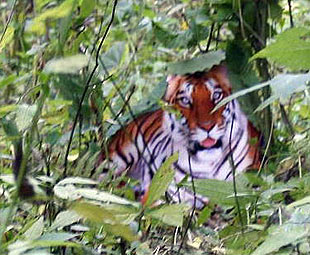
A newly-released photo, which Chinese forestry authorities say proves the continuing existence of wild South China tigers which have been thought to be extinct, has sparked heated controversy from Internet citizens, questioning its authenticity.
The digital picture, purporting to be a wild South China tiger crouching in the midst of green bushes, was released by the Forestry Department of northwest China's Shaanxi Province at a news conference on Oct. 12.
Zhou Zhenglong, 52, a farmer and former hunter in Chengguan Township of Shaanxi's Zhenping County, photographed the tiger with a digital camera and on film on the afternoon of Oct. 3, a department spokesman said.
Experts had confirmed the 40 digital pictures and 31 film photographs are genuine, the spokesman told reporters.
But dozens of netizens expressed doubts about the authenticity of the digital picture -- the only one of the 71 taken to be released at the news conference -- after it had been posted on the Internet, especially in on-line forums discussing Photoshop (PS) technologies.
Netizens suspected that the picture had been processed with PS technologies before release, citing the irregular effects of illumination and focus, and the unreal fur color of the tiger.
Some doubted whether the tiger is a wild one because its eyes look mild and dull, not frightening.
While others said that the tiger's skin and hair seem too shiny, without three-dimensional effect, and speculated that the digital picture might be taken from another picture featuring a South China tiger, or even that a tiger picture was enlarged, made into cardboard cut-out and placed in bushes before being photographed.
A forestry official in Shaanxi defended the authenticity of the digital picture on Thursday.
"Zhou Zhenglong risked his life in taking these photos, so they are very precious. We are being cautious and responsible in releasing one of the photos," said Zhu Julong, deputy head of the Provincial Forestry Department.
He added that Zhou was not a professional photographer and took these photos in a great panic because he was close to the tiger. As a result, many of the pictures are unclear, he said.
"Zhou only agreed to give us two digital pictures for release and we chose a relatively clear one," he said.
Chai Jianzhong, manager of the Xinjinhu Digital Photo Service in the provincial capital of Xi'an, also defended the authenticity of Zhou's picture.
"The color of his digital pictures is very good and looks more brilliant after being developed, but the film negatives are unclear. Technologically, the photos were not fabricated," Chai said.
"Zhou asked me to develop all the photos on Oct. 11, and specially enlarge a relatively clear one, without any other technological treatment, which was the one to be released," he said.
Xu Taoqing, a research fellow of the Shaanxi Provincial Institute of Animals Studies, said that it would be "simply impractical" for Zhou to bring either a "paper" tiger or a real, domesticated tiger to the mountain for the purposes of faking a photograph, because it was a six-hour walk from the county seat of Zhenping to the mountain.
The owner of the disputed photo, Zhou, from Wencai Village in Chengguan Township, was angered by the suspicious remarks.
"It's beyond doubt that I really took the photos of a South China tiger. If they (netizens) have doubts about the photo provided by the forestry department, they can go and ask the officials," he said.
Zhou acknowledged that he only gave two digital pictures to the forestry department, and besides, the two photos were not "the clearest ones."
Zhou has been given 20,000 yuan (US$2,666) as a reward for finding the tiger by the Shaanxi forestry authorities.
But Zhou, who believes he will be further hugely rewarded by authorities because of the photos, refused to show his original photos to reporters or anyone else.
"I must protect my intellectual property rights for which I have risked my life," he said.
Despite suspicions about the authenticity of the photo, no netizens have actually doubted the real existence of the South China tigers, an endangered tiger subspecies believed to have been extinct in the wild for more than 30 years.
The South China tiger, from which other sub-species such as the Siberian tiger evolved, is listed as one of the world's ten most endangered animals.
It is the only tiger subspecies native to China's central and southern areas. In the early 1950s, its population was 4,000 across the country. Since 1964, no sightings of wild tigers have been reported in Shaanxi.
Its former habitats were in Guangdong Province, Guangxi Zhuang Autonomous Region and the central provinces of Hunan and Jiangxi.
Xu Taoqing said that Zhenping County has been a distribution area for wild South China tigers in history, and local residents have heard roars and seen traces of tigers over recent years.
The Shaanxi Provincial Forestry Department organized a 30-member South China Tiger research team in 2006, which has carried out surveys in Zhenping since June last year. It said villagers had reported 17 sightings of South China tigers and heard their roars six times, but the claims could not be confirmed.
They also found footprints, excrement, hair and teeth of South China tigers during the survey in Zhenping, which led them to believe the tigers still exist in the wild in China.
The forestry department has banned all hunting around the mountain where the wild South China tiger was believed to be spotted and ordered checkpoints at the main entrances to the mountain area to prevent uncontrolled entry and protect the endangered species and its habitat.
"We will take this opportunity to draw up an overall protection plan and apply for establishing a nature reserve for the South China tiger in areas around the mountain," Zhu Julong said.
(Xinhua News Agency October 18, 2007)