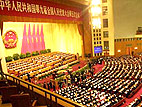
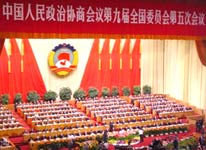
When Lei Xinquan proposed to the ongoing annual session of the National People's Congress (NPC), China's legislature, for introducing "secret ballot" to local people's congresses, he might not know that Guangdong Province, the country's reform and opening pioneer, already tried the practice in early February at its people's congress plenary session, during which the provincial government's work report was approved by 734 affirmative votes out of a total of 739 votes cast.
Lei's proposal represents an eager call from ordinary Chinese for wider scope of democracy after secret ballot has long been adopted at the lowest level -- villagers' committee election and the highest level -- the National People's Congress, and doing quite well.
However, on most occasions local people's congresses decide on bills and resolutions through voting by a show of hands, a practice that is widely feared to hinder deputies from voicing their true thoughts.
Lei, an NPC deputy from central China's Hubei Province, recalled an embarrassing scene he once witnessed when attending a provincial people's congress meeting as a nonvoting delegate. A provincial people's congress deputy showed his hand voting against the work report on the province's higher court, and caused an uproar among fellow deputies. The courageous deputy had to cover up his face with a copy of newspaper in fear of being made a fool of himself in front of the media and the public, Lei recalled, quoting the deputy concerned as saying.
What the deputy encountered contrasts strikingly with that of an NPC deputy from Guangdong a decade before when the latter proposed to adopt secret ballot at the NPC level in electing state leaders and later his motion was accepted and put into practice.
As a matter of fact, the role of China's local people's congresses has become increasingly important in recent years. In 2001, for example, the Shenyang municipal people's congress vetoed the work report of the city's intermediate court.
Interestingly, the democratic atmosphere at the highest level --the National People's Congress -- are getting stronger. In recent years at the annual sessions, it is not uncommon that some NPC deputies vote against the work reports of the Supreme People's Court and the Supreme People's Procuratorate. And even the government work reports meet with some objections.
It was unthinkable to cast a blackball at the NPC meetings years ago, but it is now just a commonplace to do so. This is not only because the deputies' awareness of democracy has greatly improved, but because China has enacted a special law to safeguard the rights and obligations of the deputies.
Awareness of democracy at the grassroots has been swelling since the country formulated the Organic Law of Villagers' Committees in 1987, according to which the villagers' committees are directly elected by villagers whereby to manage their own affairs independently.
Direct election of the township people's congress deputies can be traced back to the 1950s. And in 1979 China extended the practice to the county level, further widening the scope of democracy.
Direct election of the township and county people's congress deputies and villagers' committees is the major content of grassroots democracy. The whole process of such elections has been proven a good way to cultivate farmers' awareness of democracy.
It has taken China more than two decades to foster the awareness of democracy since its reform and opening began, and accordingly the rule of law has become the cornerstone of the country's political life.
The bottom up expansion and top down pushing of democracy are typical of the Chinese way of doing things -- grasping the two ends to bring along the middle or sustaining the advanced and helping the backward so as to spur on the vast majority.
Lei Xinquan's proposal for secret ballot at local people's congresses came naturally since both the top and the bottom are pushing hard for expanding the practice.
Excellence performance of NPC deputies from rural areas attending the ongoing NPC session demonstrates that such training has begun yielding good results. Many of the rural deputies were
reportedly outspoken and telling true stories in the presence of central leaders or local governors, observers said.
Democracy always goes together with a sound legal system, and it will be further improved at a time when China is going all out to practice the rule of law, they argued.
( March 13, 2002)