| Home / Government / Local Governments News | Tools: Save | Print | E-mail | Most Read |
| Blue-green Algae Sully Reservoir in Northeast China |
| Adjust font size: |
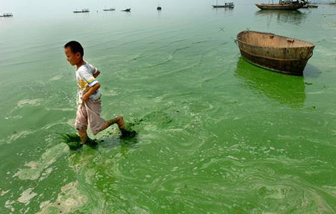
The government of Changchun City, capital of northeast China's Jilin Province, has taken emergency measures to deal with an outbreak of blue-green algae outbreak in a reservoir that provides water to the city, a government spokesman announced Sunday.
Recent outbreaks of blue-green algae in key lakes in eastern and southwestern China were mainly attributed to pollutants from chemical factories, but this time the finger is being pointed at agricultural fertilizers. Swathes of blue and green algae began to appear in Xinlicheng Reservoir, one of the city's major water sources, on Wednesday, said Xu Yifu, deputy secretary of the city government. Most of the algae are concentrated near the reservoir dykes, Xu said. He did not specify the area covered by the algae. Xu said the city government is using active carbon and chlorine to clear the water, and has dispatched workers to clean out the algae. Water pipes close to surface have been lowered to deeper waters, and floating barriers placed near the pipes to ward off the algae, Xu said. The water supply from the Xinlicheng reservoir has been cut from 100,000 tons a day to 78,000 tons a day. The shortfall is being made up from the Shitoukoumen Reservoir, another major water source for the city which provides 680,000 tons of water per day, he added. Water from the reservoir has been processed in the Third Water Processing Plant, and is safe for drinking, Qi said. Xu said the algae may have been caused by fertilizers and pesticides from nearby cropland, and the government is trying to identify the source of the pollution. He said high temperature and scant rain since June also contributed to the algae bloom, and recent downpours have nourished the algae. Changchun is home to a population of more than seven million, with 2.7 million living in the downtown area. The reservoir has a water storage capacity of 592 million cubic meters. In the last two months, blue-green algae outbreaks have been reported in Taihu Lake, Chaohu Lake and the southwestern Dianchi Lake, endangering domestic water supplies. On July 4, water supplies to 200,000 people in Shuyang county, Jiangsu Province, were halted for more than 40 hours after ammonia and nitrogen were found in a local river. (Xinhua News Agency July 16, 2007) |
| Tools: Save | Print | E-mail | Most Read |
| Related Stories |
|
|
||||||||||||
|
| Links | |||||||||||
|
