In order to reinforce the British troops surrounded by the Japanese in Burma and prevent the southwest channel from being cut, the Chinese expedition army entered Burma for the first time in 1942. After being defeated, the expedition army was incorporated into Chinese army stationed in India. Subsequently the lifeline of southwest China on land was severed.
Claire Lee Chennault, the founder of the Flying Tigers, suggested opening an air route linking India and China. The route was named "hump course" because the stretching mountains underneath the air route were like humps. The hump course was limited in transportation capacity and the cost was very high since the planes had to fly over Mt. Himalayas. Under such circumstances General Joseph Warren Stilwell, Chiang Kai-shek's chief of staff and commander of US troops in the China-Myanmar-India area, built the Burma Road, or "Stilwell Road" starting from Assam in northeast India and ending at China's Yunnan Province. The road became a lifeline for China's fight against Japanese imperialists through which munitions flew from India to China without stop.
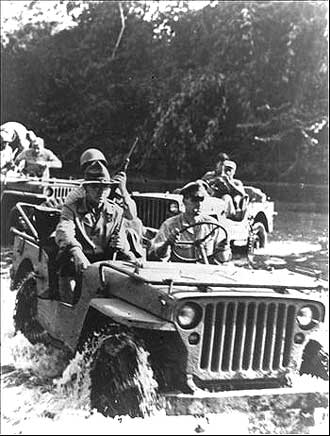
General Stilwell (L, Front) headed to north Burma to inspect Chinese troops. (People's Daily Photo)
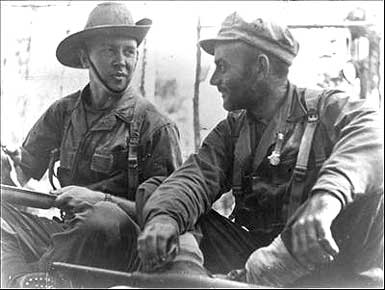
Two US soldiers arrived in China via the "Stilwell Road" in September 1944. (People's Daily Photo)
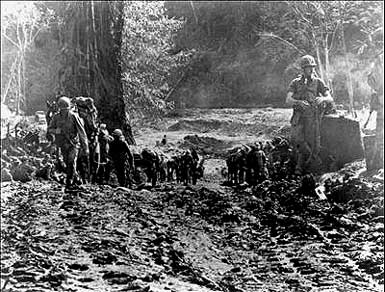
A US logistics troop was marching on the "Stilwell Road." (People's Daily Photo)
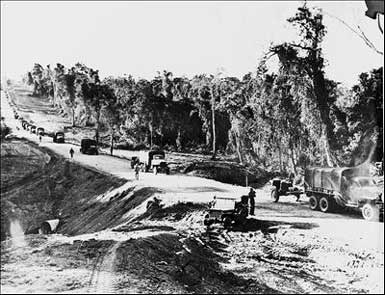
Trucks carrying munitions drove toward Kunming on the "Stilwell Road" in February 1945. (People's Daily Photo)
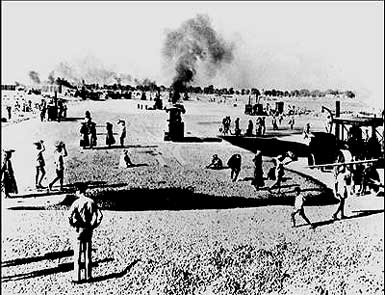
Indian workers and technicians built an airstrip in 1942. India, far from the battlefield, became the most important transit center for the Allied Force during WWII. Munitions from America would first be gathered in India and then sent to other places. (People's Daily Photo)
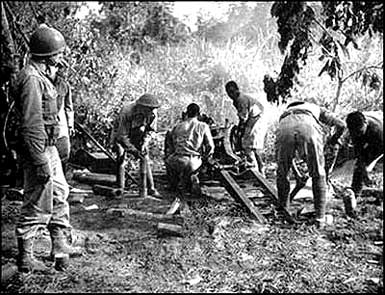
US engineering troops built the "Stilwell Road" in the forest. (People's Daily Photo)