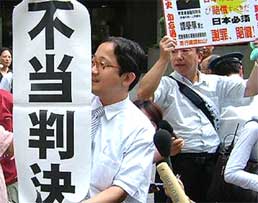
A Japanese high court on Tuesday rejected compensation appeals by 180 Chinese victims of Japan's World War II biological warfare program.
Upholding a previous lower court verdict, Tokyo High Court acknowledged damage was caused by Japan's germ warfare program in China, but ruled that the Japanese government is not liable for compensation to individual survivors.
The plaintiffs, all Chinese citizens, filed the case in 1997, demanding an apology and 10 million yen (US$89,300) each from the Japanese government.
In an August 2002 ruling, Tokyo District Court acknowledged that Japan had used biological weapons before and during World War II in violation of international conventions.
But the court rejected plaintiffs' demands for compensation, saying that under international law foreign citizens cannot seek redress directly from the Japanese government, which has already settled compensation issues under post-war peace treaties.
The Chinese government signed the Sino-Japanese Joint Statement in 1972, renouncing any claim for compensation from Japan for good.
One of the plaintiffs, Wang Xuan, lost nine relatives in a 1942 plague outbreak after the notorious Unit 731 of the Japanese Imperial Army, based in the northeastern Chinese city of Harbin, scattered lethal microbes over her village in east China's Zhejiang Province.
Wang denounced yesterday's ruling: "It's not a verdict of justice. It's impossible that individuals' right to seek compensation can be rejected this way."
She added that the plaintiffs planned to appeal to the Supreme Court.
After the ruling, nearly 90 supporters who had accompanied Wang and three other plaintiffs marched to Tokyo's government headquarters to protest.
The case has unearthed details about Japan's biological warfare program that the Japanese government and US occupation forces had allegedly kept secret after the war.
Some Japanese veterans have testified that they mass-produced cholera, dysentery, anthrax and typhoid at the unit's base in Harbin in the early 1940s.
Japan's Imperial Army is also estimated to have left behind about 2 million chemical weapons in China, which have reportedly killed over 2,000 people since 1945.
After decades of denial, Tokyo confirmed the existence of Unit 731 several years ago.
Some historians estimate that the unit may have killed as many as 250,000 people in experiments during the 1930s and 1940s, when Japanese troops occupied much of China.
(China Daily July 20, 2005)