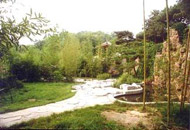
 Purple Bamboo Park is one of the seven largest parks in Beijing. It is situated at the southern end of Baishiqiao Road, with its eastern gate directly across the street from Capital Gymnasium.
The park has three connecting lakes covering 11 out of the park? s 14 hectares. Earth dredged from the lakes was pilled up to form several small hills on the eastern shore to complement the natural hills that line the lakes? western shores. Five bridges connect the lakes, islands and hills into a single integrated area. On islands and the banks of the lakes, flowering shrubs, trees and flowers have been planted with a generous hand. To the north of the lakes the famous Changhe River flows slowly by.
A temple, known in the Ming Dynasty as the Temple of Longevity (Wanshousi) originally stood to the northwest of the lake. Here the Qing rulers built a lodging palace where they and their retinues could rest as they floated to the Summer Palace or the Jade Spring Mountain on the Changhe River. Nowadays all that remains of the original temple are two stone stelae and traces of two landing platforms on the banks of the river.
The Purple Bamboo Park has a long history. According to early records, before the third century it formed the upper reaches of the Gaoliang (Sorghum) River, and a famous Gaoliang Bridge stood nearby to the east. In the Ming Dynasty, the bridge was a favorite spot for city people on the Qingming (Clear and Bright) Festival, when?young girls riding in horse-drawn carts, and city folk competing with drums and banners.? In the 13th century, the lakes of Purple Bamboo Park served as a reservoir providing an important part of Beijing? s water supply. In the late Yuan Dynasty, the mathematician and astronomer Guo Shoujing built a canal along the upper reaches of the Gaoliang River with locks to regulate the water diverted from the White River Dam, the Jade Spring Mountain, and other nearby waterways. Later, however, the canal was neglected and gradually became silted up. During the Republican period it was filled in and rented out as paddy fields.
After 1949, the People?s Government transformed the fields into a new park. Through several years of construction, the park was provided with lush bamboos and shady trees, small bridges and open-air pavilions.
In 1981, on the eve of May Day, a new two-story 1,000-square-meter waterside complex was built and opened to the public on North Mountain (Beishan) Island. It consists of the Purple Bamboo Pavilion, the Gallery for Watching the Moon, a winding walkway that leads out over the water, and a square pavilion. Though each structure is independent, from a distance the four seem to blend into one.


