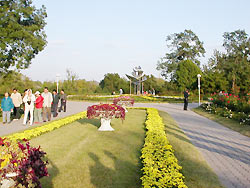
The Beijing Botanical Gardens are situated in the western outskirts of the city between Xiangshan Park and Jade Spring Mountain. Although the gardens are not large, with only some 3,000 different plant species, many famous and rare plant specimens are on display.
The hothouse exhibition, in 13 different rooms, is the highlight of the gardens. The first room is filled with evergreens and members of the palm family.
The second room is given over to tropical aquatic plants, including water lilies and flowering taros.
The third room displays commercial plants and their breeding and propagation. Here there are specimens of the triple-leaved rubber plant, cocoa and coffee trees and the sugar producing sweet-leaved chrysanthemum which has been introduced into China from abroad.
There are rooms for demonstrating medicinal plants, aromatic plants and succulents. The exhibition of ornamental plants is spectacular with its countless varieties if flowers and grasses. There are over 300 different varieties of orchid, among them a rootless one relies on fine hairs to absorb water vapor and nutrients from the air.
Besides the hothouse, there is also a national plant specimen hall with a floor space of 11,000 square meters. Specimen houses, plant classification laboratories, research rooms and a lecture hall are arranged around a courtyard linked by arches and trellises.
The Peony Garden was open to the public in 1981. It covers an area of 10 hectares and is divided into three sections. The Peony Grove is the most important, covering an area of 3.5 hectares.
The plant collection includes many rare species. There is, for example, the met sequoia first discovered in the region of Hubei and Sichuan by a Chinese scientist in the 1940s. Since it was originally believed that it had become extinct during the Tertiary Period (65 million years ago), the discovery of living specimens in China came as a tremendous surprise to botanists.
Other plants in the gardens include specimens of the nepenthes or "pitcher" plant, which "eats" insects; the golden butterfly orchid with its lustrous yellow flowers; the American redwood; the Japanese blossoming cherry, and the famous "botree," the tree under which Buddha sat when he gained enlightenment.
Address: Wo Fo Si Road, Xiangshan;
Entry ticket: 5 yuan;
Traffic:
-- By bus
Bus No.s 331, 904, 737, 714, 833, 733, 318, 360, mini-23, mini-66. There are two main visitor entrances on Xiangshan Nanlu and Xiangyi Lu;
-- By car
From Summer Palace: Continue straight onto Xiangyi Lu and drive 10 kilometers and turn right to the parking lot;
-- From Fifth Circle Highway
Exit at Fragrant Hill; drive 0.8 kilometers and turn right to the parking lot;
-- Parking
There is a visitor entrance and attended parking (for a fee) at South Gate.
Parking lot opens at 8:00 AM and close at 6:00 PM . There is no overnight parking. Buses only when space permits;
Tel: 86-10-62591283.
(China.org.cn)