|
Fifty-six Ethnic Groups
|
| |
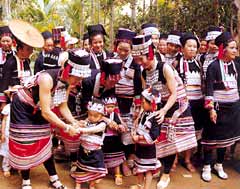 China is a united multi-ethnic nation of 56 ethnic groups. As the majority of the population is of the Han ethnic group (accounting for 91.6 percent of the national total population), China?s other 55 ethnic groups are customarily referred to as the national minorities. The national minorities which have a population of over one million include the Zhuang, Manchu, Hui, Miao, Uygur, Yi, Tujia, Mongolian, Tibetan, Bouyei, Dong, Yao, Korean, Bai, Hani, Li, Kazak and Dai, totaling 18 ethnic groups. Among them the Zhuang ethnic group has the biggest population of 15.556 million. There are 15 ethnic groups with a population of between 100,000 and one million, including She, Lisu, Gelo, Lahu, Dongxiang, Va, Shui, Naxi, Qiang, Tu, Xibe, Mulam, Kirgiz, Daur and Jingpo. And 22 ethnic groups have a population of between 10,000 and 100,000: Salar, Blang, Maonan, Tajik, Pumi, Achang, Nu, Ewenki, Jing, Jino, Deang, Ozbek, Russian, Yugur, Bonan, Moinba, Oroqen, Drung, Tatar, Hezhen, Gaoshan (excluding the population of the Gaoshan ethnic group in Taiwan) and Lhoba. The Lhoba ethnic group has the smallest population, with less than 3,000.
The Han people can be found throughout the country, mainly on the middle and lower reaches of the Yellow River, the Yangtze River and the Pearl River valleys, and the Northeast Plain. The national minorities, though fewer in number, are also scattered over vast areas and can be found in approximately 64.3 percent of China, mainly distributed in the border areas of northeast, north, northwest and southwest China. Yunnan Province, home to more than 20 ethnic groups, has the greatest diversity of ethnic groups in China. Taking shape over China?s long history, this circumstance of different ethnic groups ?living together in one area while still living in individual compact communities in special areas? continues to provide the practical basis for political, economic and cultural intercourse between the Han and the various minority peoples, and for the functioning of the regional ethnic autonomy system.
|
|
|