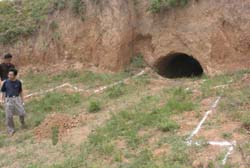
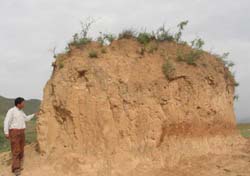
The recent discovery of the Western Zhou (c. 1046-771 BC) cemetery has made a stir in Chinese archaeological circles, and is being heralded by top archaeological experts as a find of great significance.
Over the weekend, a group of high-ranking archaeologists and experts from Beijing led by Shan Jixiang, director of the State Administration of Cultural Heritage, inspected the cemetery excavation located in Qishan County, Shaanxi Province in Northwest China.
"This cemetery ruins should be treated in accordance with State regulations and requirements of a historical ruins by first-class State protection, and should be protected with best measures," Shan said.
Local officials said armed police will soon be guarding the site.
And the county government of Qishan has decided that construction projects will be banned and any on-going projects will be stopped in an area covering 10 square kilometers.
"It is still too early to come to a conclusion who the hosts of the tombs in this Western Zhou cemetery were," Shan said. "A great deal of research should be done and it will take years."
Huang Jinglue, former deputy director of the State cultural heritage administration and member of the investigation group from Beijing, said the Western Zhou cemetery find is uniquely large scale and has never been seen before.
The regular arrangement of the tombs with the largest tomb at the highest position shows that the cemetery belongs to high-ranking people in the Western Zhou Dynasty, probably a king, Huang said.
Shan suggested that a special research and protection team for the newly discovered cemetery should be established, with the site made a key scientific research project.
However, Shan did not specify when or if the tombs will be opened.
"The next step of work should be focused on further investigation," Shan said. "Blind digs without careful preparation and scientific excavation plans will do more harm than good."
Another group member Zhang Zhongpei, a former director of the Palace Museum and noted archaeologist, said researchers need to analyze the entire layout and work out a long-term excavation plan.
The large scale tomb group is located next to the Zhou Gong Temple, which has been investigated and excavated since March by a joint-archaeological team with experts from the provincial archaeology research institute and Peking University.
The Zhou Gong Temple, located about seven kilometers from Qishan County seat, was built in the Tang Dynasty (618-907) to commemorate Zhou Gong, the regent of the newly established Western Zhou Dynasty.
In the past two months, the researchers have found 19 tombs at those cemetery ruins. Among them, nine have four tunnels, an indicator that they were only for high-ranking people, according to the team head Wang Zhankui.
By comparison, they also found four tombs with three tunnels, four tombs with two tunnels and two with one tunnel. Another 13 accompany funeral pits.
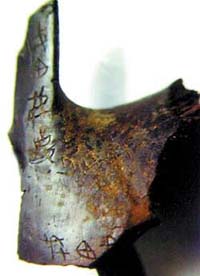
Meanwhile, some 700 pieces of jiaguwen, tortoise shell inscribed with Chinese characters, were unearthed. Of those, four pieces bore the characters "Zhou Gong," which are the first ever unearthed pieces with such characters, Wang said.
"And we also found some 1,500 meters of rammed earth walls and six large-scale rammed building foundations built in Western Zhou Dynasty," Wang said.
Moreover, seven chariot pits were also discovered, Wang said.
Zou Heng, a 78-year-old professor of Peking University and known as the top archaeologist on Western Zhou, said the discovery of the jiaguwen, rammed-earth wall, rammed building foundations and tombs associated with the Western Zhou Dynasty, which are concentrated in one place, is in itself a historical event in the 70 years of archaeological excavation on Western Zhou.
(China Daily June 8, 2004)