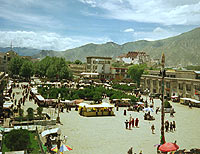
China has unveiled a large-scale renovation of Bargor Street, the bustling religious, tourist and commercial center of Lhasa, capital of southwest China's Tibet Autonomous Region.
The facelift will take two years to complete at a cost of 70 million yuan (US$8.4 million) to be provided by the central government.
Work started recently on 56 dilapidated courtyards which have long been in disrepair.
"The current renovation aims to better preserve the distinctiveTibetan buildings. It will be carried out in strictly accordance with the state's decrees on protecting ancient architecture. No destruction of Tibetan-style buildings is occurring as some Westerners have claimed," said Guo Bao, director of the Lhasa Bureau of Cultural Heritage Protection.
Bargor Street, which snakes its way around the incense-redolent Johkang Monastery in downtown Lhasa, was formed some 1,300 years ago after Srongtsan Ganpo, the first ruler of unified Tibet, married Chinese princess Wencheng and built the Johkang Monastery.
Most of the houses along the street are white, Tibetan-style buildings with black doors and windows draped with beautiful curtains. On the roofs fly long, narrow and colorful flags.
The oldest urban center in Lhasa, Bargor Street extends one kilometer with 35 lanes radiating from it. Today, 50,000 tourists and businessmen pour into this thoroughfare every day.
Many houses in Bargor Street are run down with leaking roofs. Some are dangerous to live in. Fire brigades and garbage collectors find it difficult to manouevre in and out of the narrowlanes, a hidden danger to the Johkang Monastery and other older buildings.
"The renovation will follow the principle of keeping the street's original layout and building style. But indoor facilities and infrastructure will be upgraded so local people can live comfortably," said Zhaxi Doje, head of the Standing Committee of the Lhasa City People's Congress.
Tibetan architects will be invited to repair buildings at risk of collapse after years of neglect as they are familiar with Tibetan structures.
When the renovation project finishes in 2003, 1,095 local residents will no longer have to worry about leaking houses in therainy season or their safety in dangerous rooms.
Bargor Street buildings would be maintained as well-preserved ancient architecture both inside and out after the facelift, said Qoi'gyai Gyiancai, a noted Tibetan architect.
(Xinhua News Agency July 25, 2002)