China's better-than-expected economic performance in January and February indicated that the country is capable of meeting its growth target this year, China's top economic planner said Thursday.
Zeng Peiyan, minister of the State Development and Planning Commission, said: "The overall economic situation is better than we had predicted. The GDP (gross domestic product) growth rate for the first two months has remained at 7 percent. As China's economy tends to accelerate in following months, I think our all-year growth target of 7 percent is attainable.''
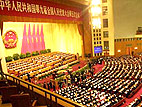
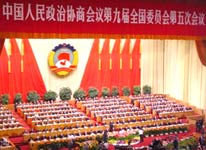
At Thursday's press conference for the Fifth Session of the Ninth National People's Congress, Zeng also unveiled the long-awaited reform plan for the power sector. This aims to break up the virtual monopoly of the State Power Corporation of China.
Zeng said the government plans to separate the electricity-generating and transmission assets of the corporation, which controls over half of China's power plants and almost all the power grids. Most of the company's generating assets will be injected into three or four new power-generation groups to let them compete across the nation.
The power-transmission assets of the State Power Corporation are expected to be split into five regional grid companies, in which the State Power Corporation will hold the controlling shares. Another independent grid company would be set up to cover the southern provinces.
Zeng said all the power plants should compete to transmit their electricity over power networks, and an independent committee would be set up to supervise the power sector.
"As for the current contracts with foreign companies, they could either keep their contracts unchanged or they could negotiate new ones,'' said Zeng.
To solve the electricity shortage in the 1980s, China promised each foreign investor in the domestic power sector a stable high profit return for 10 to 20 years.
Zeng admitted that China's entry to the World Trade Organization could be painful for less efficient industries such as motor manufacturing and pharmaceuticals, and also lead to an increased oversupply of grain and further joblessness.
"We should provide favorable policies and systems to protect our industries and agriculture, as the WTO rules allow,'' said Zeng.
"Compared with other WTO members, our support for agriculture is much less. We are very much justified in lending more support,'' said Zeng.
He added that China will seek to expand exports and imports to keep foreign trade balanced.
"We would provide tax rebates for the exports of qualified companies, abolish additional fees on exports of grain and cotton, and perfect our examination system on imports,'' said Zeng.
He also said the commission is working in conjunction with the Hong Kong Special Administrative Region and the neighboring Guangdong and Fujian provinces in South China, to avoid competition between them in finance, trade, tourism, and infrastructure construction.
(China Daily March 8, 2002)