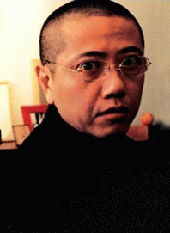
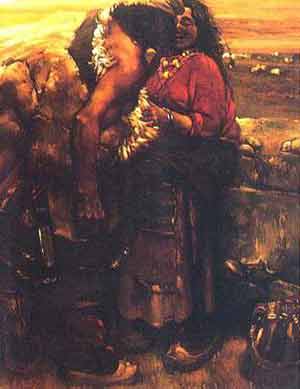
Chen Danqing established his name almost over night in the 1980s with his seven paintings portraying Tibetans, which he created in an effort to imitate French Realist artist Jean-Francois Millet.
That decade saw oil painting break from being propaganda medium and return to an art form. Chen's art was a part of this conversion.
Three years after the Cultural Revolution (1966-1976) began, Chen, at the age of 16, was sent to the countryside of south Jiangxi Province for five years. This time was to be a turning point in Chen's life.
In 1974, Chen displayed two of his works, On the Frontier and Spring Snow. The talent displayed in these pieces gave Chen the chance to leave the countryside and enter the world of fine arts.
In 1978, even though he was only a graduate of middle school, Chen was admitted to the master's program at the China Central Academy of Fine Arts, the only art academy directly under the Ministry of Education. In 1982, he left for the US and lived there for almost 20 years.
Life in America was difficult for Chen for the first five or six years, during which he admitted he was depressed. Later, he opened his own gallery in New York, where he met many contemporary Chinese artists. Yet Chen decided to return to China to teach what he had learned in the west.
one of Chen Danqing's paintings portraying Tibetans
In the year 2000, assigned as a supervisor at the Academy of Arts and Design at Tsinghua University, Chen handpicked 5 students from a large number of candidates who he believed had artistic talent. He taught them painting, but only to find none of them were able to graduate because they all failed the final exam in English.
Hence came Chen's most ruthless attack on art education in China. Chen declared that to use English as a pre-screening device for student recruitment and professorial qualification is completely meaningless. This was not Chen's only criticism of art education. In the following years, Chen did not recruit any students for he could not find one that both satisfied his artistic ideas and had certain other qualifications required by the national education system. So in 2005, Chen decided to quit Tsinghua University. The decision soon aroused a heated debate over the art education system in China.
Chen has always been known as a gifted painter, and public figure. Just as Weng Yunpeng, one of Chen's first five students, said, "Danqing has never been just a painter. He is an intellectual with a social conscience." After leaving Tsinghua University, Chen dedicated most of his time to writing books on politics, literature, and of course, painting and art education.
(chinaculture September 1, 2006)